The Ethics of Lightness: How Jonathan Chapman’s Philosophy Shapes Modern EVs
 Apr, 19 2026
Quick Takeaways
- Lightness isn't just about speed; it's about reducing the total energy required for every mile.
- Adding bigger batteries creates a 'weight spiral' that increases tire wear and energy waste.
- Material choices like carbon fiber and aluminum are tools, but the real win comes from structural efficiency.
- True sustainability means considering the energy cost of producing a vehicle, not just driving it.
The Weight Spiral: Why Bigger Isn't Always Better
Imagine you're packing for a trip. You realize you don't have enough clothes, so you buy a bigger suitcase. But the bigger suitcase is heavier, so you need a stronger car to carry it, which uses more fuel, so you decide you need a bigger fuel tank. This is exactly what is happening in the current Electric Vehicle (EV) market. Engineers add a 100kWh battery to get more range, but that battery weighs 500kg. To support that weight, they need beefier suspension, larger brakes, and reinforced frames. Suddenly, the car is so heavy that it eats up the extra range provided by the bigger battery.
Chapman argues that this approach is fundamentally flawed. When we ignore the ethics of lightness, we ignore the physics of efficiency. Every extra kilogram requires more energy to accelerate from a stop and more energy to keep moving against rolling resistance. By focusing on the battery as the only solution, we've stopped asking how to make the car itself more efficient. This creates a hidden cost: heavier cars chew through tires faster, releasing more microplastics into the environment, and they cause more wear and tear on roads.
Material Science vs. Structural Intelligence
When designers talk about lightweighting, they often jump straight to expensive materials. They mention Carbon Fiber, which is a polymer consisting of long, thin strands of carbon atoms bonded together in a crystal alignment, or Aluminum alloys. While these materials are great, Chapman’s ideas suggest that the shape and logic of the design matter more than the material. Using a fancy material to build a heavy, inefficient shape is a waste of resources.
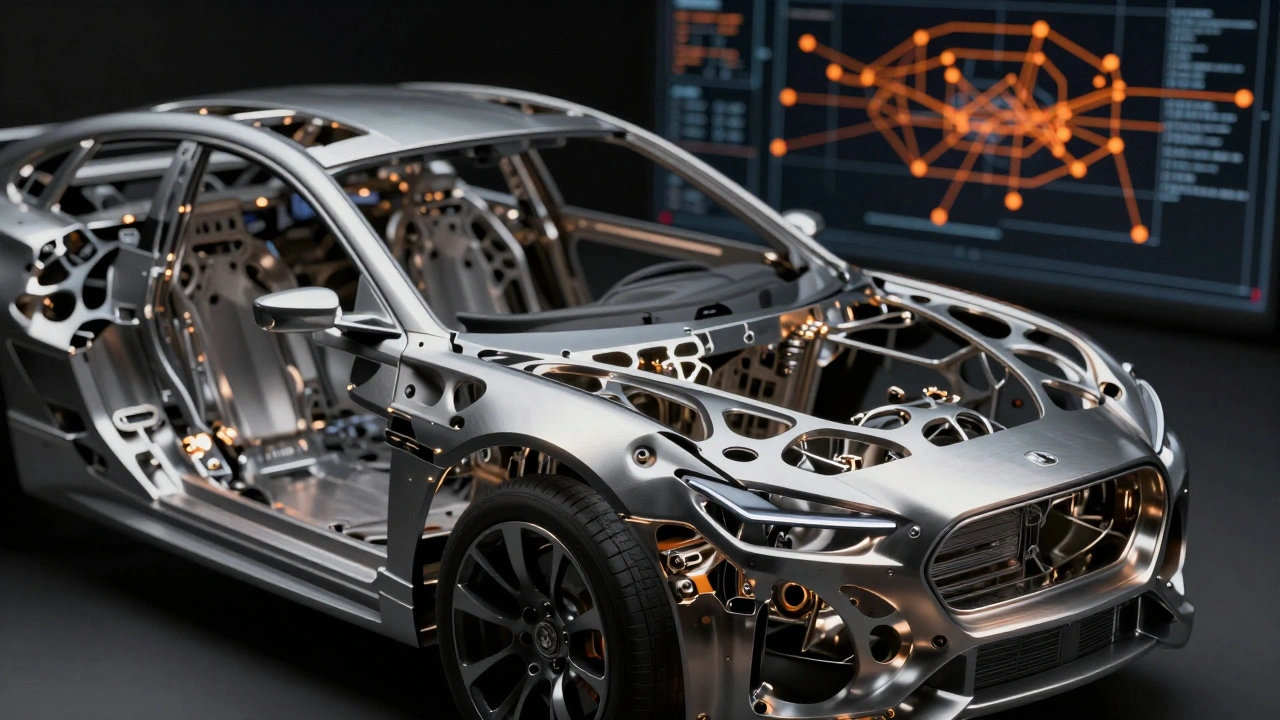
Structural intelligence means placing material only where it is absolutely needed. It's the difference between a solid block of steel and a cleverly engineered honeycomb structure. For example, in high-end performance EVs, we see a shift toward "megacasting"-using huge single-piece casts to replace dozens of smaller stamped parts. This reduces the number of bolts and welds, cutting weight without sacrificing safety. This is a practical application of the ethics of lightness: achieving the same goal (a safe, rigid chassis) with the least amount of physical matter.
| Approach | Primary Method | Impact on Efficiency | Environmental Trade-off |
|---|---|---|---|
| Energy Expansion | Larger Battery Packs | Diminishing returns due to mass | Higher mining impact (Lithium/Cobalt) |
| Material Substitution | Carbon Fiber / Magnesium | High weight reduction | Expensive and harder to recycle |
| Structural Logic | Topological Optimization | Maximum efficiency per kg | Requires advanced AI/Simulation tools |
The Environmental Cost of Heavy Cars
We often talk about "zero emissions" at the tailpipe, but the ethics of lightness forces us to look at the total lifecycle. Producing a massive battery requires an enormous amount of energy and mining. If we can reduce a car's weight by 20%, we might be able to use a battery that is 20% smaller while maintaining the same range. This directly reduces the amount of cobalt and lithium pulled from the earth.
Moreover, heavier EVs are harder to stop. This leads to a reliance on massive brakes that generate significant dust. A lighter car requires smaller brakes and less energy for regenerative braking. When you look at it this way, lightness isn't a luxury for sports cars; it's a requirement for a sustainable planet. If the goal is to reduce the overall footprint of transport, we have to stop thinking of the car as a vessel for a battery and start thinking of it as a highly optimized tool for movement.
Practical Application: How to Implement Lightness Today
So, how does this actually work in a production environment? It starts with Topological Optimization, which is a mathematical method that optimizes material layout within a given design space for a given set of loads. Instead of a human engineer guessing where a bracket needs to be thick, software simulates thousands of stress points and removes every single gram of metal that isn't doing a job. The result looks organic-almost like a bone-rather than a traditional machine part.
Another step is the shift toward Cell-to-Chassis (CTC) technology. Normally, batteries are put into a module, then the module is put into a pack, and the pack is bolted into the car. That's three layers of redundant housing. CTC integrates the battery cells directly into the car's structure, making the battery part of the frame itself. This eliminates the dead weight of the casings and allows for a lower center of gravity, improving handling and efficiency simultaneously.

Moving Toward a New Design Legacy
The legacy of automotive design has long been about "more": more horsepower, more leather, more screens, more size. But the EV transition offers us a chance to pivot toward "better." Better means a car that does exactly what it needs to do and nothing more. When we apply Chapman's ideas, we realize that the most sophisticated piece of technology isn't the one with the most features, but the one that achieves the most with the least.
This requires a cultural shift in the industry. We need to stop praising the "longest range" and start praising the "best range-to-weight ratio." If a car can travel 300 miles on a small, light battery, it is technically and ethically superior to a car that travels 400 miles but weighs as much as a small truck. The future of mobility isn't about how much energy we can carry, but how little we actually need to move.
Does lightweighting make electric cars less safe?
Not at all. Modern lightweighting focuses on structural efficiency. By using materials like high-strength steel or aluminum in strategic "crumple zones" and reinforced cells, engineers can actually make a car safer while reducing its overall weight. The goal is to manage energy during a crash more effectively, not just to use less material.
Why is carbon fiber not used in every EV?
Cost and recyclability. Carbon fiber is incredibly light and strong, but it is expensive to produce and very difficult to recycle at the end of the vehicle's life. For a mass-market car, aluminum or advanced high-strength steels provide a better balance of cost, weight, and environmental sustainability.
What is the 'weight spiral' in EV design?
The weight spiral happens when a designer adds a larger battery to increase range, which increases the car's weight. This extra weight then requires heavier brakes, tires, and suspension, which in turn reduces efficiency, prompting the designer to add even more battery to compensate.
How does Jonathan Chapman's philosophy differ from standard engineering?
Standard engineering often treats weight as a constraint to be managed after the design is set. Chapman treats lightness as a primary ethical goal. Instead of asking "How do we make this light?", he asks "Why is this here at all?" and "What is the minimum amount of matter required to perform this function?"
Will lighter EVs actually cost less to buy?
In the short term, some lightweight materials are more expensive. However, reducing the size of the battery pack-the most expensive component of an EV-can significantly lower the overall cost of production and the final retail price.
Next Steps for Enthusiasts and Buyers
If you're looking for your next EV, stop looking only at the maximum range number. Instead, look at the curb weight and compare it to the battery capacity. A car that achieves high efficiency with a smaller battery is a sign of better engineering and a more sustainable design philosophy. Support brands that prioritize aerodynamic efficiency and structural lightness over sheer battery size. By voting with your wallet, you encourage the industry to move away from the weight spiral and toward a truly ethical approach to mobility.