Racing Reliability Strategies: British Approaches to Testing and Failure Proofing
 Mar, 2 2026
When you watch a Formula 1 car tear down a straight at over 200 mph, it looks like pure speed. But what you’re really seeing is reliability under extreme pressure. A single failed bolt, a cracked heat shield, or a misbehaving sensor can turn a championship contender into a smoldering heap in seconds. British teams have dominated top-level motorsport for decades-not just because of their aerodynamics or engine power, but because they built a culture around making things that don’t break.
Why British Teams Win at Reliability
The UK doesn’t have the biggest budgets or the most exotic materials. What it does have is a deep-rooted engineering philosophy shaped by decades of competition. From Silverstone to Milton Keynes, British racing teams developed a system that treats failure not as an accident, but as data. Every time a part fails, it’s not a setback-it’s a lesson written in metal and carbon fiber.Teams like McLaren, Red Bull Racing, and Williams didn’t just inherit this mindset. They built it. In the 1980s, when other teams were chasing raw power, British engineers started asking: How many laps can this component survive before it dies? They didn’t just test parts under ideal conditions. They tested them under the worst conditions they could imagine.
The Four Pillars of British Failure Proofing
There’s no single secret. It’s a system built on four interconnected practices.- Stress Testing Beyond Limits - British teams don’t just run components at their rated capacity. They push them 30% past the theoretical limit. A suspension arm designed for 10,000 cycles? They run it for 13,000. If it holds, they tweak the design. If it breaks, they study the fracture pattern down to the microcrack.
- Environmental Simulation - A race car doesn’t just face heat and vibration. It faces freezing rain in Silverstone, desert sand in Bahrain, and humidity in Singapore. British teams use climate chambers that mimic every condition a car might encounter. One team at Williams even built a replica of the Monaco tunnel to test how exhaust gases behave under pressure.
- Redundancy Without Bloat - Unlike some teams that add backup systems like extra wiring or duplicate sensors, British engineers prefer smarter redundancy. For example, instead of adding a second fuel pump, they designed one pump that could self-diagnose and shift modes if flow dropped below 92%. Less weight. More intelligence.
- Failure Debriefs That Don’t Blame - After every race, every failure, no matter how small, gets logged in a public database. Not just the part number. Not just the time. But the exact conditions: tire pressure, ambient temperature, driver input, even the track surface roughness. And crucially-no one gets fired for a failure. The goal is to learn, not punish.
How They Test: The Real-World Lab
Most companies test in controlled environments. British teams test in chaos.At the McLaren Technology Centre, they don’t just use dynamometers. They have a race simulator rig that mounts a full car on hydraulic actuators. It doesn’t just simulate cornering forces-it recreates the exact bumps, kerbs, and vibrations of 12 different circuits. Engineers watch high-speed cameras of suspension arms flexing under load. They listen for the first hint of a creak. They measure how a bolt loosens over 100 laps of simulated racing.
One of the most telling examples came in 2022, when Red Bull’s RB18 had a tiny oil leak during testing. It wasn’t a big leak. No performance loss. No warning lights. But the team shut down the entire test program for three days. They traced it to a single weld joint on the oil pan that was 0.05mm off-spec. They replaced 87 units. No one outside the team even knew about it. That’s the standard.

Materials and Manufacturing: The Quiet Advantage
British teams don’t always use the most expensive materials. They use the most predictable ones.Take carbon fiber. Most teams use off-the-shelf prepreg. British teams developed their own layup schedules based on decades of failure analysis. They know exactly how a 12-layer weave behaves under 1,200G lateral loads. They’ve seen how humidity affects curing time. They’ve mapped the fatigue life of each resin system.
At Aston Martin’s base in Silverstone, they use a custom CNC milling process for titanium components. The machines are set to cut 5% slower than industry standard. Why? Because they found that slower cuts reduce internal stress fractures by 40%. The extra time costs money. The extra reliability saves races.
The Human Factor: Engineers Who Live the Data
Reliability isn’t just about machines. It’s about people.At Williams, every engineer who designs a part must also sit through at least one race weekend in the pit lane. They watch how the part behaves under real stress. They hear the radio chatter. They see the team’s reaction when something fails. One engineer told me: “If you’ve never heard a team lead scream because a sensor died on lap 3, you don’t know what reliability really means.”
They also rotate engineers between design, testing, and race operations. No one stays in a silo. A designer who’s seen a part break on track will change the next version. A mechanic who’s replaced a failed valve cover will tell the CAD team exactly where the stress points are.
What Other Teams Get Wrong
Many teams think reliability means using thicker parts, heavier materials, or more sensors. That’s not British thinking.British teams ask: What’s the smallest change that prevents the biggest failure? They don’t add a backup system. They redesign the load path. They don’t add a second temperature sensor. They move the existing one to a cooler spot. They don’t increase the torque spec. They change the bolt material to one that doesn’t creep under heat.
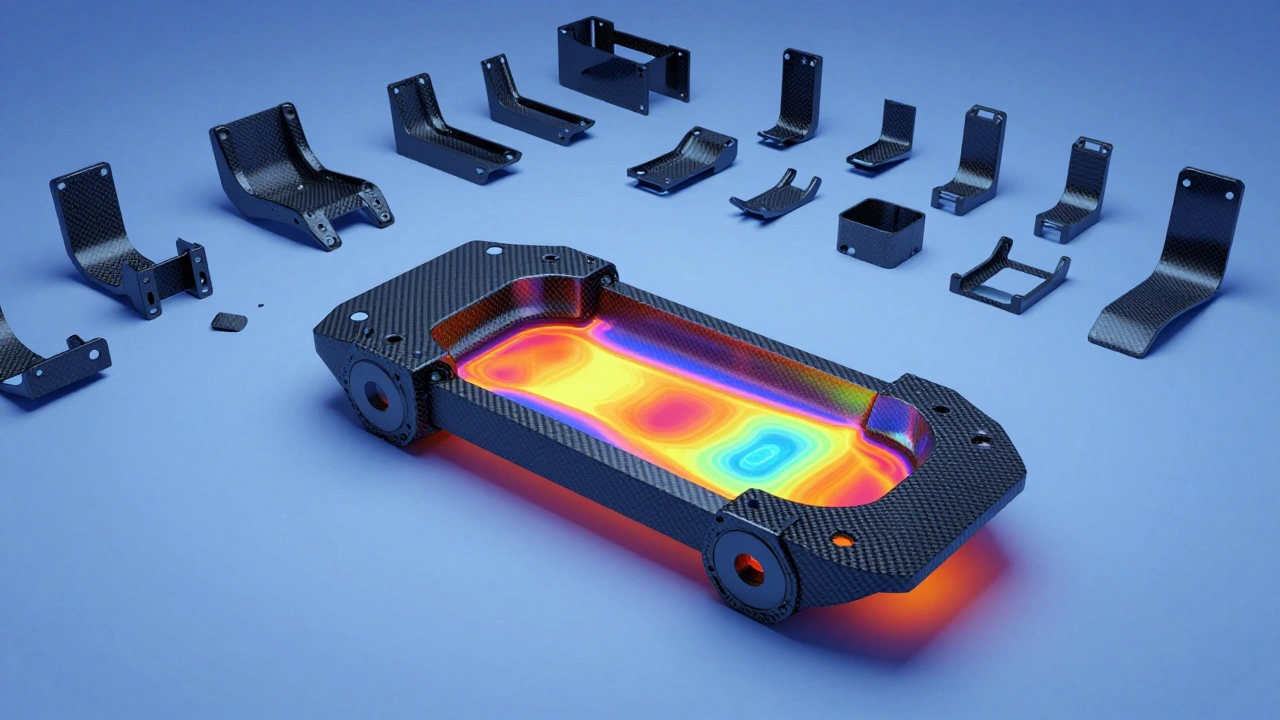
One team in 2024 replaced a 150-gram bracket with a 75-gram version that was 20% stronger. How? By studying the failure modes of 47 previous brackets and eliminating every unnecessary curve. The result? Less weight, better airflow, and zero failures in 87 races.
Lessons Beyond the Track
You don’t need to build a Formula 1 car to use these principles.Think about your car’s engine. Why does it last 200,000 miles? Because engineers tested it under freezing winters, desert heat, and stop-and-go traffic-not just in a lab. Think about your smartphone. Why doesn’t it crack when dropped? Because someone dropped it 10,000 times and watched how the case failed.
The British approach teaches us that reliability isn’t about perfection. It’s about understanding failure so well that you stop it before it happens. It’s not about building something that can’t break. It’s about building something that tells you exactly how it’s going to break-before it ever does.
Why do British teams focus on failure instead of performance?
Because in racing, performance means nothing if the car doesn’t finish. A car that’s fast but breaks on lap 10 is useless. British teams realized early that winning isn’t about being the fastest on paper-it’s about being the most consistent. By studying every failure, they find the hidden weaknesses that no one else sees. That’s how they turn a 10th-place car into a championship winner.
Do British teams use more expensive materials than others?
Not necessarily. They often use standard materials but treat them differently. For example, they might use the same titanium alloy as everyone else, but they control the manufacturing process with extreme precision-slower machining, tighter heat treatment, and detailed post-production inspection. The difference isn’t the material. It’s how they make it.
How do British teams handle component testing differently?
Most teams test to specification. British teams test beyond specification. They’ll run a suspension link for 150% of its expected life. They’ll heat it to 180°C when the max is 140°C. They simulate every possible failure mode-bumps, vibrations, thermal shock, even contamination from track debris. They don’t just want to know if it works. They want to know exactly how it fails, and why.
Is reliability more important than speed in racing?
Speed gets you on the grid. Reliability gets you on the podium. In Formula 1, teams that lead in reliability consistently finish in the top three-even if they’re not the fastest on a single lap. Over a 22-race season, the team that finishes every race with minimal downtime will almost always win the championship. Speed is flashy. Reliability is quiet, but it wins.
Can amateur racers apply British reliability methods?
Absolutely. Start small. Log every failure-no matter how minor. Was a bolt loose? A sensor glitch? A tire wear pattern? Write it down. Then, next time, ask: What’s the smallest change that prevents this? Maybe it’s a different torque setting. Maybe it’s cleaning a connector. You don’t need a $100 million lab. You just need curiosity and discipline.