McLaren’s Carbon Monocoque Advantage: British Composites in Road Cars
 Oct, 6 2026
Imagine lifting a car’s entire skeleton with one hand. It sounds like science fiction, but for McLaren, this is just Tuesday. The secret isn’t magic; it’s the carbon fiber monocoque. This single-piece safety cell is the backbone of every modern McLaren road car, from the entry-level Artura to the flagship P1. But why does this matter to you? Because weight is the enemy of performance, and stiffness is the foundation of handling.
You might think all cars are built the same way: a steel frame wrapped in metal skin. That’s true for most vehicles on the road. But when you’re pushing speeds over 200 mph or navigating tight corners at the limit, steel becomes a liability. It’s heavy. It flexes. Enter the Monocage, a carbon-fiber reinforced polymer (CFRP) structure that acts as both the chassis and the crash structure. Developed by McLaren’s engineering team in Woking, UK, this technology migrated from Formula 1 race cars to street-legal supercars, changing how we think about automotive design.
Why Steel Can’t Keep Up With Modern Performance
Let’s get real about materials. Traditional unibody construction uses high-strength steel or aluminum. These metals are great for mass production because they’re cheap and easy to stamp into shape. But they have limits. To make a steel chassis stiff enough for high-performance driving, engineers have to add more material. More material means more weight. More weight means slower acceleration, longer braking distances, and higher fuel consumption.
Carbon fiber flips this equation. A carbon fiber monocoque can be up to 70% lighter than an equivalent steel structure while being significantly stiffer. Stiffness is crucial because it keeps the suspension geometry precise. If your chassis twists when you turn the wheel, your tires lose contact with the road. You feel vague steering inputs and unpredictable behavior. With a rigid carbon tub, the wheels do exactly what you tell them to do.
This isn’t just theoretical. When McLaren launched the MP4-12C in 2011, they proved that a carbon chassis could be durable enough for daily driving. Previous attempts at carbon-bodied cars often struggled with repairability and cost. McLaren solved this by designing the Monocage to absorb impact energy efficiently, reducing the need for massive crumple zones made of heavier metals.
The Science Behind the Weave
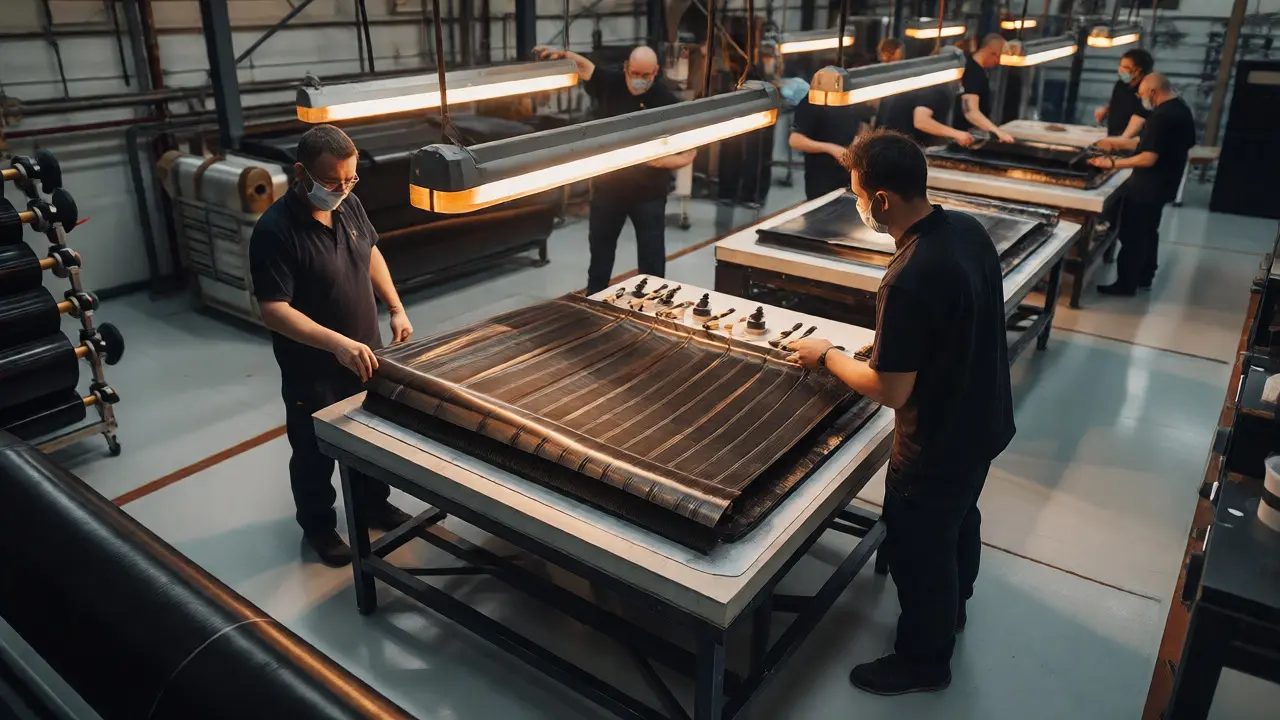
Not all carbon fiber is created equal. The strength of a composite material depends on how the fibers are laid down and bonded together. McLaren uses a process called autoclave curing. Imagine baking a cake under extreme pressure and heat. In an autoclave, layers of carbon fabric are infused with resin and heated to around 180°C (356°F) under high pressure. This removes air bubbles and ensures the resin fully saturates the fibers.
The result is a part with exceptional strength-to-weight ratio. Engineers can tailor the layup direction to handle specific loads. For example, the front of the car needs to resist crushing forces in a frontal collision, so the fibers are oriented to manage compression. The sides need to resist side impacts, so the weave is adjusted for shear strength. This level of customization is impossible with stamped metal, which has uniform properties in all directions.
| Property | High-Strength Steel | Aluminum Alloy | Carbon Fiber (CFRP) |
|---|---|---|---|
| Density (kg/m³) | ~7,850 | ~2,700 | ~1,600 |
| Tensile Strength (MPa) | ~1,000 | ~400 | ~3,500+ |
| Repair Complexity | Low | Medium | High |
| Production Cost | Low | Medium | High |
| Stiffness per Unit Weight | Baseline | +20% | +300% |
British Engineering and the Supply Chain
There’s a reason McLaren chose to stay in the UK. Britain has a deep heritage in aerospace and composite manufacturing. Companies like GKN Aerospace and various suppliers in the Midlands specialize in advanced materials. By keeping production close to home, McLaren maintains tight control over quality. They don’t just buy off-the-shelf parts; they co-develop the materials with their suppliers.
This vertical integration allows for rapid iteration. If a new type of resin improves cure times, McLaren can test it immediately without waiting for overseas shipments. It also supports the local economy and creates specialized jobs. The skills required to lay up complex carbon structures aren’t found everywhere. They require trained technicians who understand the nuances of fiber orientation and resin flow.
However, this comes with challenges. Carbon fiber production is energy-intensive. The process of turning polyacrylonitrile (PAN) precursor into carbon fiber requires high temperatures and inert atmospheres. Critics argue that the environmental footprint of producing carbon fiber is higher than recycling steel. McLaren addresses this by focusing on longevity and efficiency. A lighter car uses less energy to move, offsetting some of the production costs over the vehicle’s life.
From Race Track to Road Car
The transfer of technology from Formula 1 to road cars is often exaggerated. In reality, it’s a slow, careful process. F1 teams change chassis designs every year. Road cars need to last ten years or more. They must withstand potholes, speed bumps, salt, mud, and accidental curb strikes. A component that works perfectly in a controlled racing environment might fail after five winters in Chicago.
McLaren bridges this gap through rigorous testing. Each Monocage undergoes destructive testing. They crush samples to failure points, simulate rollovers, and expose them to extreme temperature cycles. They also use digital twins-virtual models that predict how the structure will behave under stress before physical prototypes are even built. This reduces development time and ensures reliability.
The payoff is evident in the driving dynamics. Drivers often describe the sensation of a carbon-chassis car as "connected." There’s no lag between input and response. The cabin feels solid, with minimal noise, vibration, and harshness (NVH). This refinement contributes to the premium feel that justifies the price tag.

The Cost and Repair Reality
Owning a carbon-chassis car isn’t just about bragging rights. It changes how you maintain and repair the vehicle. If you dent a steel bumper, a body shop can hammer it out. If you crack a carbon panel, it might need replacement. Structural damage to the monocoque itself is rare but serious. It often requires specialized equipment and expertise to assess and repair.
Insurance premiums for these cars reflect this risk. Insurers know that repairs can be costly and time-consuming. Parts availability can also be an issue. Unlike steel panels, which can be fabricated quickly, carbon parts are often molded to order. This means longer wait times if something breaks.
Yet, many owners find the trade-off worth it. The performance gains are tangible. Fuel economy improves, especially in hybrid models like the McLaren Artura, which combines a lightweight carbon architecture with electric powertrain components. The reduced mass means the engine doesn’t work as hard to accelerate the car, extending its lifespan and improving efficiency.
Future Trends in Composite Construction
The industry is moving toward faster production methods. Traditional autoclave curing takes hours. New techniques like Resin Transfer Molding (RTM) and automated fiber placement promise to reduce cycle times. This could make carbon chassis more accessible to mainstream manufacturers. BMW already uses carbon-reinforced plastic in its i-series, proving that the technology can scale beyond supercars.
We’re also seeing advancements in recyclability. Researchers are developing thermoplastic resins that allow carbon parts to be melted down and reused. This could address the environmental concerns associated with current thermoset resins, which cannot be remelted once cured. As sustainability becomes a bigger factor in purchasing decisions, these innovations will become critical.
For now, McLaren remains a leader in demonstrating that carbon fiber isn’t just for race cars. It’s a viable, durable, and superior solution for high-performance road vehicles. The combination of British engineering precision and advanced materials science continues to set the benchmark for what’s possible in automotive design.
Is a carbon fiber chassis safer than steel?
Yes, generally speaking. Carbon fiber monocoques are extremely strong and rigid, providing excellent protection in crashes. They absorb energy efficiently and maintain the integrity of the passenger cell better than many steel structures. However, repairability is lower, so minor accidents can be more costly.
How much does a McLaren carbon tub weigh?
The exact weight varies by model, but a typical McLaren carbon fiber monocoque weighs between 75 and 90 kilograms (approx. 165-200 lbs). This is significantly lighter than an equivalent steel or aluminum chassis, contributing to the car's overall low center of gravity.
Can I repair a cracked carbon fiber part myself?
Minor cosmetic cracks can sometimes be repaired by specialists using epoxy fillers and clear coats. However, structural damage usually requires professional assessment. DIY repairs are risky because improper bonding can compromise strength. Always consult a certified specialist for structural issues.
Why is carbon fiber so expensive?
Carbon fiber is expensive due to the complex manufacturing process. Producing the fibers requires high temperatures and specialized equipment. Layup and curing are labor-intensive and time-consuming. Additionally, the raw materials themselves cost more than steel or aluminum.
Do all McLaren cars use a carbon monocoque?
Most modern McLaren road cars do, including the 720S, 750S, GT, and Artura. Older models like the MP4-12C also featured carbon structures. McLaren has committed to this technology across its lineup to ensure consistent performance characteristics.