McLaren Engineering: How Weight, Power, and Packaging Define a British Supercar
 May, 13 2026
Most people look at a McLaren and see speed. They see the sleek curves, the aggressive stance, and the badge that screams exclusivity. But if you sit with an engineer from Woking, Surrey, they won't talk about top speed first. They will talk about weight. In the world of high-performance engineering, weight is not just a number on a scale; it is the enemy of everything else. Acceleration, braking, cornering, fuel efficiency-every single metric suffers when mass increases. McLaren’s entire philosophy, dating back to its Formula 1 roots, revolves around one brutal truth: lighter is faster.
This isn't just about shaving grams off a door handle. It is about a radical approach to vehicle architecture. When you strip away the non-essentials, you are left with a structure that must do more with less. This article breaks down how McLaren balances three critical forces: minimizing weight, maximizing power, and managing the physical space (packaging) required to make it all work in a car you can actually drive on the street.
The Carbon Fiber Monocoque: The Foundation of Lightness
To understand McLaren's engineering model, you have to start with the chassis. Most car manufacturers build their vehicles on steel or aluminum frames. These materials are heavy. Even when reinforced, they add significant mass to the final product. McLaren took a different path, pioneered by Peter Stevens in the 1980s with the MP4/1 F1 car and later adapted for road cars like the F1 and the P1.
The Carbon Fiber Monocoque (CFM) is the heart of every modern McLaren. Unlike traditional construction where a frame supports body panels, the monocoque is the structural integrity of the car. It acts as both the safety cell and the foundation upon which everything else is mounted. By using pre-preg carbon fiber-a material made of carbon strands impregnated with resin and cured under heat and pressure-McLaren creates a structure that is incredibly stiff yet remarkably light.
The benefits are immediate. A typical steel unibody might weigh several hundred kilograms more than a CFM. That saved weight doesn't just disappear; it translates directly into performance. For every kilogram removed, the car accelerates quicker, brakes shorter, and handles corners with greater precision. The stiffness of the carbon fiber also means the suspension can be tuned more precisely because the chassis doesn't flex under load. You get sharper steering response and better tire contact with the road.
- Weight Savings: The CFM is significantly lighter than equivalent steel or aluminum structures.
- Stiffness: High torsional rigidity allows for precise suspension geometry.
- Safety: Carbon fiber absorbs crash energy effectively, protecting the driver.
This architectural choice dictates everything else. Because the central tube is so compact, engineers can place components closer together. This leads us to the next challenge: packaging.
Extreme Packaging: The Mid-Engine Advantage
If you've ever opened the hood of a front-engine sports car, you know there's a lot of empty space. Or worse, a long engine block that pushes the front axle forward, creating a "long nose" design. This increases the wheelbase but also adds weight to the front end, which can cause understeer (the tendency for the front wheels to slide during turns).
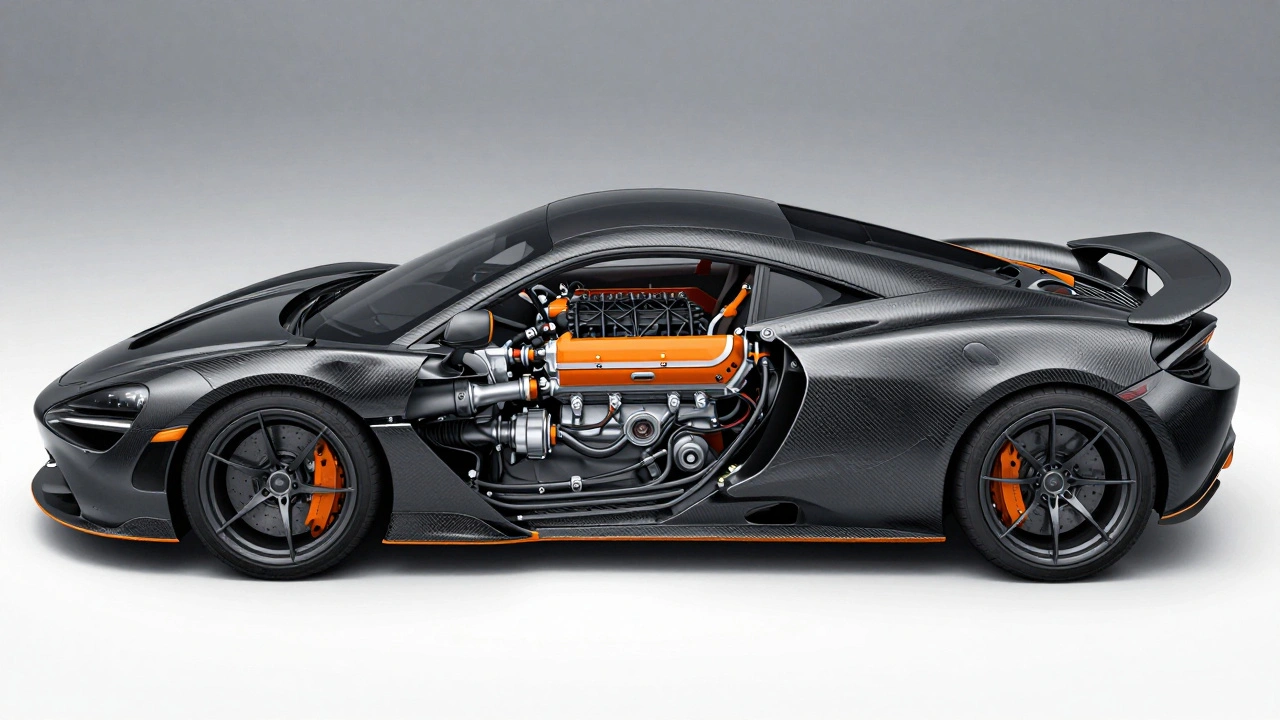
McLaren uses a mid-engine layout. The engine sits behind the driver but in front of the rear axle. This placement offers two massive advantages: perfect weight distribution and improved aerodynamics. However, it creates a unique engineering puzzle known as "extreme packaging."
In a conventional car, the engine bay is large. In a McLaren, the space available for the engine, transmission, cooling systems, and battery (in hybrids) is tightly constrained by the shape of the carbon fiber tub. Engineers have to fit complex machinery into a narrow, low-profile slot. This requires custom-designed components. Manifolds, intercoolers, and radiators are often shaped specifically to fit around the monocoque walls rather than being standard off-the-shelf parts.
This tight packaging lowers the center of gravity. By keeping heavy components low and centered between the axles, the car feels planted. It reduces body roll during cornering and improves traction during acceleration. The result is a car that feels smaller and more agile than its actual dimensions suggest. You don't just drive a McLaren; you feel connected to every movement of the machine.
Power Delivery: From V8s to Hybrid Systems
Once the chassis is built and the space is defined, you need power. McLaren has historically relied on naturally aspirated engines, but the industry shift toward electrification has changed the game. Today, McLaren combines internal combustion engines with electric motors to create hybrid supercars.
The current flagship models use a twin-turbocharged 4.0-liter V8 engine. Why a V8? It offers a great balance of size, weight, and power potential. Compared to a V10 or V12, a V8 is more compact, allowing for better packaging within the mid-engine bay. Twin turbos help overcome the lag associated with forced induction, providing instant torque delivery.
But the real magic happens with the integration of electric motors. In models like the Artura, McLaren introduces a hybrid system that includes a permanent magnet synchronous motor (PMSM). This electric motor is integrated directly into the gearbox, not bolted on as an afterthought. This keeps the drivetrain compact and maintains the low center of gravity.
The electric motor provides instant torque fill-in when the turbochargers are spooling up. It also allows for "e-boost," giving the car extra power for overtaking or track laps. Crucially, the electric system helps regenerate braking energy, improving efficiency without adding significant weight. The goal isn't just to go fast; it's to go fast efficiently, reducing drag on the mechanical components and extending maintenance intervals.
| Attribute | Naturally Aspirated V10/V12 | Twin-Turbo V8 + Hybrid |
|---|---|---|
| Complexity | Mechanical simplicity | High complexity (software + hardware) |
| Packaging Size | Larger footprint | Compact, fits tighter spaces |
| Torque Delivery | Linear, RPM-dependent | Instant, flat torque curve |
| Emissions Compliance | Difficult to meet modern standards | Easier via electric assist |

The Active Dynamics: Managing Power and Weight
You can have the lightest car and the most powerful engine, but if you can't put that power to the ground, it's useless. This is where McLaren's active dynamics come into play. Technology like Proactive Chassis Control (PCC) uses sensors to read the road surface hundreds of times per second.
Before the wheel even hits a bump, the suspension adjusts to counteract the impact. This keeps the tires flat against the road, maximizing grip. In a lightweight car, this is crucial. There's less mass to press the tires down, so any loss of contact means a loss of control. PCC ensures that the car remains stable whether you're cruising on the highway or attacking a mountain pass.
Another key component is the electronic differential. It manages torque distribution between the rear wheels independently. If the car senses it's starting to oversteer (spin out), it can instantly send more power to the inside wheel to pull the car straight. If it's understeering, it powers the outside wheel to rotate the car into the turn. This system works seamlessly with the lightweight chassis to provide a driving experience that feels intuitive rather than mechanical.
Real-World Implications: Why This Matters to Drivers
All this engineering jargon might seem abstract, but the results are tangible. When you buy a McLaren, you aren't just buying a status symbol; you're buying a specific driving dynamic.
First, there's agility. Because the car is light and stiff, it changes direction instantly. There's no hesitation, no body float. Second, there's responsiveness. The throttle input translates directly to motion. Third, there's efficiency. Modern McLarens can drive in pure electric mode for short distances, making them viable for daily use in city centers with low-emission zones.
Consider the Artura. It produces over 680 horsepower but weighs only about 1,498 kilograms dry. That gives it a power-to-weight ratio of roughly 453 hp per ton. Compare that to a traditional luxury grand tourer, which might produce similar power but weigh nearly twice as much. The difference in acceleration, braking distance, and handling is night and day.
Why does McLaren use carbon fiber instead of aluminum?
Carbon fiber is significantly stronger and stiffer than aluminum while being much lighter. This allows McLaren to build a chassis that resists twisting under stress, improving handling precision. Aluminum would require thicker sections to achieve similar strength, adding unwanted weight.
What is the benefit of a mid-engine layout?
A mid-engine layout places the heaviest component (the engine) between the front and rear axles. This creates a near-perfect 50:50 weight distribution, enhancing balance and stability during cornering. It also lowers the center of gravity, reducing body roll.
How does hybrid technology affect the driving experience?
Hybrid systems provide instant torque from electric motors, eliminating turbo lag. This makes the car feel more responsive at low speeds. Additionally, regenerative braking captures energy that would otherwise be lost, improving overall efficiency without compromising performance.
Is the carbon fiber monocoque safe?
Yes, extremely. Carbon fiber has excellent energy absorption properties. In a crash, it dissipates force effectively, protecting the occupants. McLaren subjects its monocoques to rigorous testing, including full-width offset crashes and rollover simulations, to ensure highest safety standards.
What is Proactive Chassis Control (PCC)?
PCC is an advanced suspension system that uses cameras and sensors to scan the road ahead. It adjusts the dampers before the wheels hit bumps or dips, maintaining optimal tire contact with the road for better grip and comfort.