Lotus Engineering: Bringing Ground Effect and Monocoque to the Street
 Apr, 12 2026
The Magic of Ground Effect Aerodynamics
Most people think of spoilers and wings when they hear 'aerodynamics.' They're thinking of pushing the car down from the top. But Ground Effect is a different beast entirely. It’s about manipulating the air *underneath* the car to create a vacuum. Think of it like a giant vacuum cleaner suctioning the chassis to the road.
This started gaining traction in the 1970s. Colin Chapman, the founder of Lotus, realized that if you shape the underbody of a car like an inverted wing (a Venturi tunnel), the air accelerates as it moves through a narrow space. According to Bernoulli's principle, faster-moving air has lower pressure. When the pressure under the car drops significantly lower than the atmospheric pressure pushing down on the roof, the car is effectively sucked onto the track.
On the track, this allowed the Lotus 79 to take corners at speeds that seemed physically impossible. But bringing this to the road is a nightmare. Why? Because a road isn't a smooth billiard table. Potholes, speed bumps, and road debris can break the 'seal' of the vacuum. If a car loses that seal suddenly, you get a massive loss of downforce, and the car can lift off the ground-a terrifying phenomenon known as aero-lift.
| Feature | Traditional Wing/Spoiler | Ground Effect (Venturi) |
|---|---|---|
| Primary Action | Pushes car down via air pressure | Sucks car down via low-pressure vacuum |
| Drag Penalty | High (creates a 'parachute' effect) | Low (integrated into the floor) |
| Sensitivity | Consistent across heights | Highly sensitive to ride height |
| Road Practicality | Easy to implement | Difficult due to ground clearance |
The Monocoque Revolution: Strength Without Weight
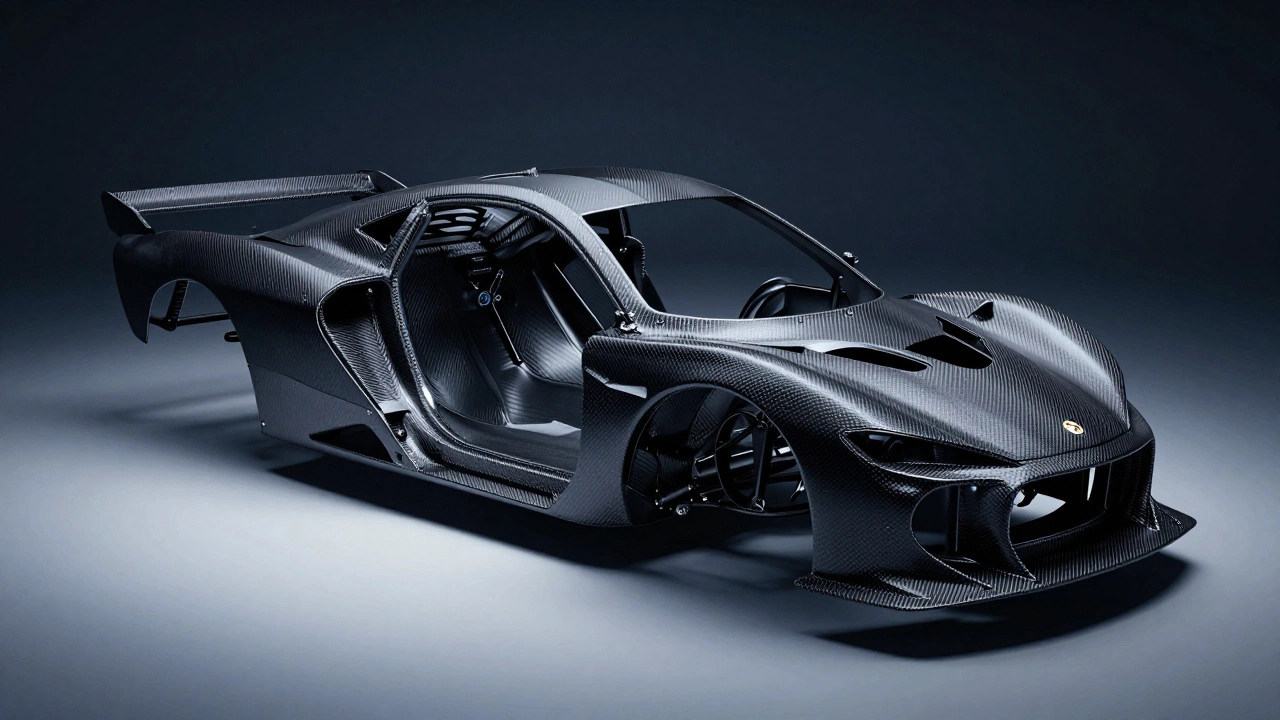
For years, cars were built using a 'body-on-frame' design. You had a heavy steel ladder frame, and you bolted the body on top. It was sturdy, but it was dead weight. Lotus flipped the script by perfecting the Monocoque. In French, it literally means 'single shell.' Instead of a separate frame, the skin of the car *is* the structure.
Think of it like an eggshell. If you squeeze an egg from the top and bottom, it's incredibly strong because the stress is distributed across the entire surface. Lotus applied this to racing first, creating a carbon-fiber survival cell. This wasn't just about speed; it was about survival. In a crash, a monocoque doesn't just bend; it absorbs and dissipates energy more effectively than a steel rail.
When this tech migrated to road cars, it solved a classic dilemma: how do you make a car safe without making it weigh as much as a tank? By using composite materials and strategic bracing, Lotus could build a chassis that was stiffer than steel but weighed a fraction of the amount. This rigidity means the suspension can do its job perfectly because the chassis isn't flexing like a wet noodle while you're cornering.
From Circuit to Commute: The Engineering Trade-off
You can't just copy-paste a Formula 1 car into a driveway. There are real-world physics that get in the way. For instance, the Carbon Fiber used in monocoques is expensive and hard to repair. If you dent a steel door, you beat it back with a hammer. If you crack a carbon fiber tub, you're looking at a specialized autoclave and a very expensive bill.
Then there's the issue of 'stiffness.' A race-grade monocoque is so stiff that every single pebble on the road is transmitted directly to the driver's spine. To make these cars livable for the street, Lotus had to introduce compliance-essentially building in a tiny bit of 'give' without sacrificing the structural integrity. This is why you'll see a mix of aluminum and composites in their road-going models; it provides a balance of weight, cost, and comfort.
The Impact on Modern Performance Cars
If you drive a modern supercar today, you're driving a descendant of Lotus's experiments. The concept of an 'active aero' system-where the car adjusts its flaps and ride height in real-time-is a direct evolution of the struggle to keep ground effect stable on uneven surfaces. The goal is always the same: maximize the contact patch of the tires by using the air as an invisible weight.
We also see the monocoque's legacy in the safety cells of almost every modern vehicle. Even your daily driver likely has a 'safety cage' integrated into the body structure, which is a simplified version of the high-strength tubs found in a Lotus Evija. The shift from heavy iron to lightweight, high-strength materials is the single biggest leap in automotive safety in the last fifty years.

Common Pitfalls in Performance Tuning
Many enthusiasts try to mimic these 'track' innovations on their own cars, often with disastrous results. Adding a massive wing to a car with a 'leaky' underbody is like trying to glue a piece of paper to a table using a single drop of glue on the corner. You get the drag (the wind resistance) without the actual grip.
Real performance comes from the bottom up. If you want better handling, start with a flat floor or a rear diffuser before adding a wing. A diffuser helps the air exit from under the car more smoothly, which prevents the 'turbulent wake' that slows you down. It's a lesson Lotus learned the hard way: the most important parts of the car are the ones you can't see from the driver's seat.
Does ground effect work at low speeds?
Not really. Ground effect relies on air velocity. Until you reach a certain speed-usually around 60-80 mph-the pressure differential isn't strong enough to create significant downforce. That's why race cars rely on mechanical grip (tires and suspension) for slow corners and aero for the fast ones.
Is a monocoque chassis always better than a space frame?
In terms of stiffness-to-weight ratio, yes. However, space frames are much easier and cheaper to build and modify. For a custom kit car or a low-volume prototype, a space frame is often more practical. For mass production and high-speed safety, the monocoque wins every time.
Why aren't all road cars designed with ground effect?
Ride height is the biggest enemy. Ground effect requires the car to be very close to the road to maintain the low-pressure seal. Most road cars need enough clearance to go over speed bumps and drive up steep driveways. If a ground-effect car hits a bump at high speed, it can lose grip instantly, which is dangerous for the average driver.
What material is the best for a monocoque?
Carbon fiber reinforced polymer (CFRP) is the gold standard for performance because it's incredibly light and stiff. However, aluminum is a great middle-ground for road cars, offering a good balance of crash energy absorption and weight reduction.
How does a diffuser actually help?
A diffuser is the expanding section at the rear of the car's floor. It gradually slows down the fast-moving air coming from the underbody, allowing it to rejoin the slower ambient air behind the car. This reduces turbulence and 'pulls' more air through the Venturi tunnels, increasing the overall ground effect.
Next Steps for Performance Enthusiasts
If you're looking to improve your own car's dynamics, don't start with a bolt-on wing. Look at your underbody. Even adding a simple flat plastic sheet to the bottom of your car can reduce turbulence and slightly improve stability at highway speeds. If you're into the DIY scene, studying how to brace your existing chassis to mimic the rigidity of a monocoque is a much more rewarding project than adding cosmetic aero parts.
For those interested in the cutting edge, keep an eye on electric vehicle (EV) platforms. Because EVs don't need a transmission tunnel, they are essentially giant monocoque 'skateboards.' This opens up a whole new world of interior space and aerodynamic potential that Colin Chapman would have loved.