Interwar British Automobiles 1920 to 1939: How Technology and Market Shifts Reshaped the Industry
 Feb, 27 2026
Between 1920 and 1939, British car makers didn’t just build vehicles-they built a global reputation. This wasn’t a time of flashy innovation like today, but a quiet, powerful consolidation. Cars went from hand-built curiosities to mass-produced machines, and Britain led the way. By 1939, the UK was producing more cars than any other country in the world except the United States. But how did that happen? What changed in the engines, the factories, and the minds of buyers?
The Rise of the Mass Market
In 1920, owning a car was still a luxury for the wealthy. Most British cars were made in small workshops, with each vehicle assembled by hand. The Rolls-Royce Phantom I, for example, cost over £2,000-equivalent to more than £120,000 today. But by 1930, that price had dropped sharply. The Austin 7, introduced in 1922, changed everything. At just £175, it was affordable to middle-class families. Over 200,000 were sold in the UK alone by 1939. It wasn’t just cheap-it was reliable, easy to repair, and small enough for city streets. Suddenly, a teacher, a shopkeeper, or a clerk could own a car.
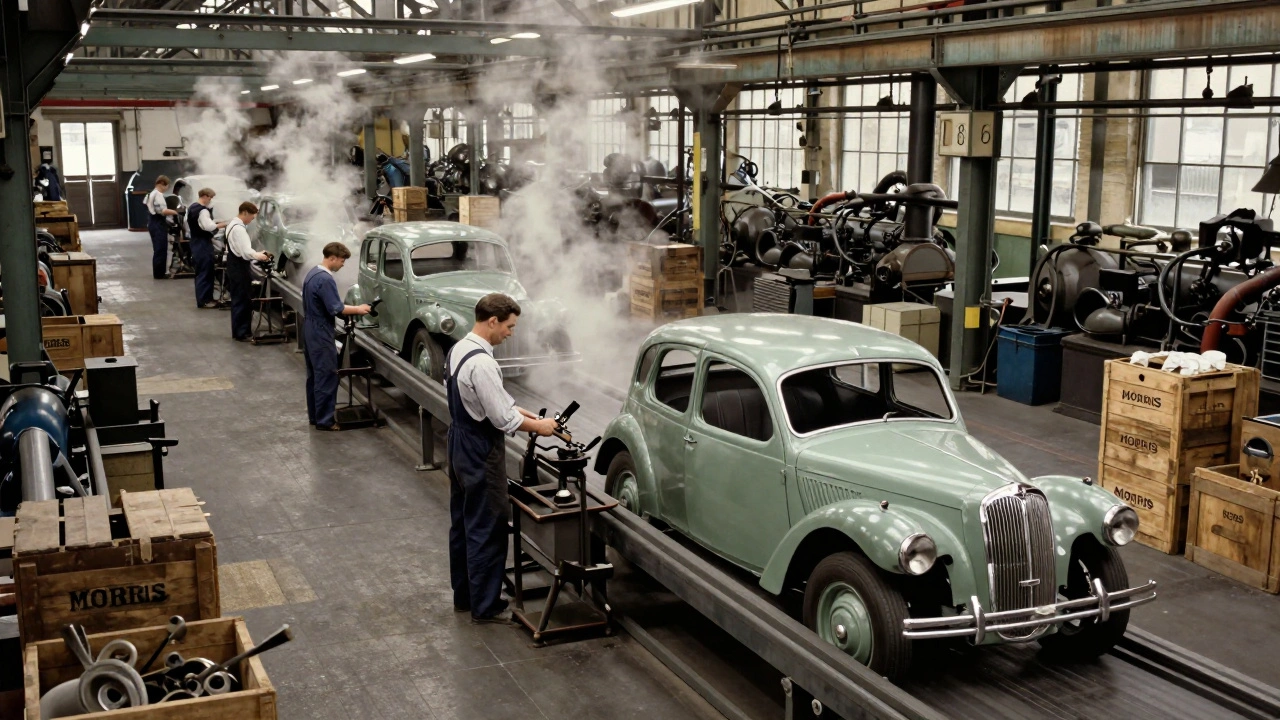
Other manufacturers followed. Morris Motors, under William Morris, became the biggest carmaker in Britain. He didn’t just build cars-he built factories. His Cowley plant in Oxford turned out over 100,000 cars a year by the late 1930s. Ford’s British operations, based in Dagenham, added even more volume. By 1937, Britain produced over 400,000 cars annually. That’s more than the entire output of Germany and France combined.
Technology That Moved the Needle
While American cars leaned on V8 engines and bold styling, British manufacturers focused on efficiency and refinement. The key breakthroughs weren’t about raw power-they were about making cars easier to live with.
- Pressurized cooling systems replaced simple radiators, preventing overheating on long drives.
- Four-wheel brakes became standard by 1935, cutting stopping distances by nearly 40% compared to rear-only brakes.
- Independent front suspension, first used by Alvis in 1927, made rides smoother and handling more predictable.
- Electric starters replaced hand cranks by the early 1930s, removing one of the biggest barriers to driving-especially for women.
Transmission design also evolved. Three-speed gearboxes became common, and synchromesh gearboxes-first introduced by Cotal in 1929-made shifting smoother. No more grinding gears. That alone made driving less intimidating for new owners.
Engine design shifted too. The inline-four remained king, but engineers improved efficiency. The 1934 Hillman Minx used a 1,185 cc engine that delivered 28 horsepower-enough to hit 65 mph. That’s faster than most 1920s luxury cars.
Market Shifts: Who Bought What?
The British car market didn’t just grow-it split. By the mid-1930s, three clear segments emerged:
- Entry-level cars like the Austin 7 and Morris Minor targeted working-class buyers. They were simple, durable, and cheap to run.
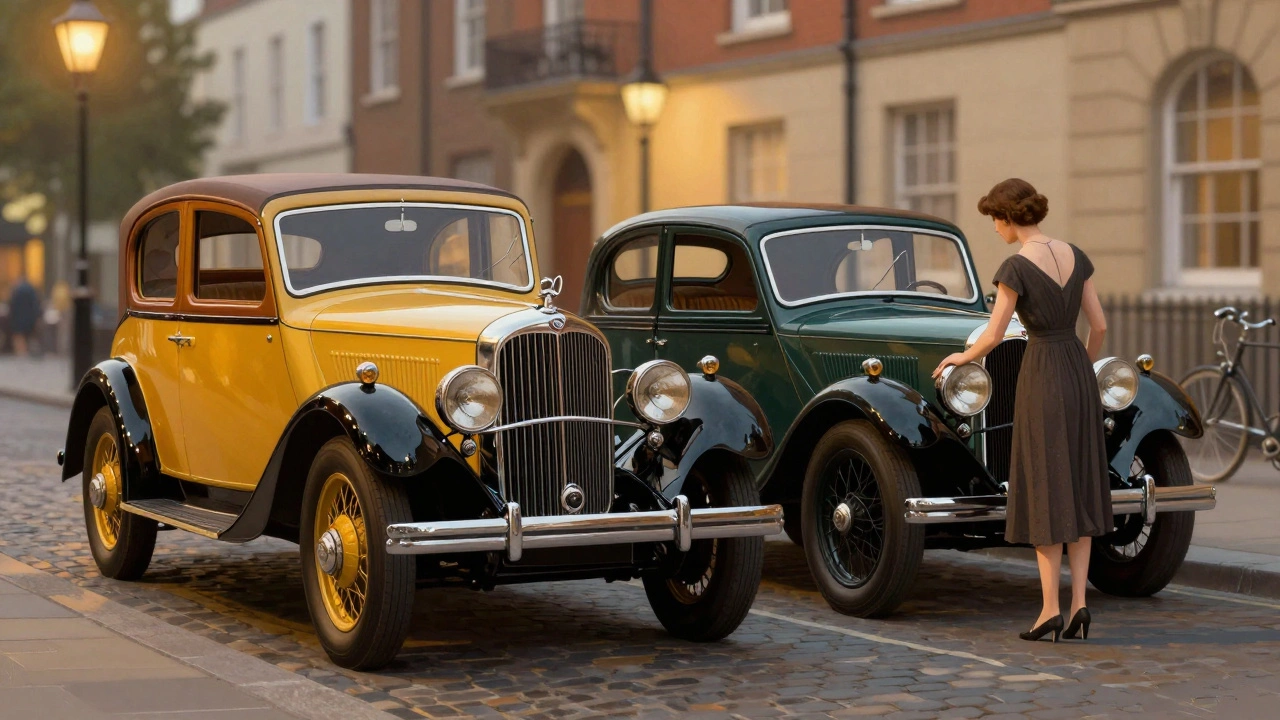
- Mid-range cars like the Vauxhall 12-4 and Standard Ten appealed to professionals. They offered more comfort, better interiors, and optional extras like electric lights and windscreen wipers.
- Luxury cars like the Rolls-Royce Phantom, Bentley 4½ Litre, and Lagonda Rapier stayed true to their pre-war roots. These weren’t for commuting-they were for status. Some were even sold without bodies, leaving custom coachbuilders like Mulliner or Barker to craft the chassis into a unique masterpiece.
Women drivers became a major force. By 1938, nearly one in five car owners in Britain was a woman. Manufacturers responded with softer colors, easier controls, and marketing that emphasized safety and elegance over speed.
Factory Life and Labor
The shift to mass production didn’t just change cars-it changed workers. The Ford Model T assembly line came to Britain in the 1920s, but British factories adapted it. Instead of rigid, repetitive tasks, many plants introduced job rotation and skill training. At Morris’s Cowley plant, workers were given basic mechanical training. That meant fewer breakdowns and more pride in the product.
Unionization grew too. The Transport and General Workers’ Union, founded in 1922, organized car factory workers. Strikes in 1926 and 1931 forced manufacturers to improve wages and conditions. By 1937, the average factory worker in Coventry earned £3.50 a week-enough to buy a secondhand Austin 7 every three years.
Export Powerhouse
British cars didn’t just sell at home-they dominated the world. By 1938, nearly half of all British cars were exported. India, Australia, Canada, and South Africa were major markets. The Austin 7 was so popular in India that it became the backbone of local repair shops. Local mechanics learned to rebuild them using scrap parts. In Australia, the Hillman Minx was so common that it was nicknamed the "Australian national car."
Even in the U.S., British cars found a niche. The MG TC, introduced in 1945 but designed in the late 1930s, became a cult favorite among American enthusiasts. But even before that, Bentley and Rolls-Royce were symbols of prestige. A British car in 1935 wasn’t just transportation-it was proof you’d made it.
The End of an Era
By 1939, Britain stood at the peak of its pre-war automotive power. Over 700,000 cars were produced that year. But the war changed everything. Factories turned to tanks and planes. Design teams were drafted. The elegant lines of the 1930s gave way to wartime utility.
What survived was a legacy. The technologies developed between 1920 and 1939-four-wheel brakes, electric starters, independent suspension-became standard everywhere. The mass-market approach pioneered by Morris and Austin shaped how cars were made for decades.
And the cars themselves? Today, a well-preserved 1932 Bentley 4½ Litre sells for over £1 million. An Austin 7 in good condition fetches £20,000. They’re not just classics. They’re proof that Britain didn’t just build cars in the interwar years-it built the blueprint for the modern automobile.
Why did British cars dominate exports in the 1930s?
British cars dominated exports because they offered a rare mix of quality, reliability, and affordability. While American cars were cheaper but less refined, and German cars were more complex, British manufacturers struck a balance. The Austin 7, for example, was simple enough to repair anywhere in the Empire, yet built to last. British engineering had a global reputation for precision, and the British Empire’s trade networks made distribution easy. Factories in Coventry and Birmingham shipped cars to every corner of the world-from Nairobi to New Zealand.
How did the Austin 7 change the British car market?
The Austin 7 was the first truly affordable car for the middle class. Before it, cars were either luxury items or unreliable knock-offs. The Austin 7 cost less than a good motorcycle, had a proven engine, and was easy to maintain. It created a new class of drivers-teachers, clerks, shopkeepers-who didn’t need a chauffeur. It also inspired countless imitators and spawned a whole industry of tuning and racing. The "7" became the foundation for Britain’s postwar car culture.
What role did women play in the interwar British car market?
Women became a major force in the car market between 1920 and 1939. By 1938, nearly 20% of car owners in Britain were women. Manufacturers responded by designing cars with softer interiors, better visibility, and easier controls. Advertisements focused on safety, independence, and convenience-not speed. Electric starters, which replaced hand cranks, were especially important because they made driving accessible to women who might not have had the physical strength to crank a cold engine. This shift laid the groundwork for women’s mobility in the decades that followed.
Why didn’t British carmakers adopt V8 engines like the Americans?
British manufacturers prioritized efficiency and refinement over raw power. American V8s were loud, thirsty, and expensive to maintain. British engineers focused on improving four-cylinder engines with better valve timing, lighter materials, and improved cooling. They knew most drivers didn’t need 100 horsepower-they needed smooth acceleration, low fuel use, and reliability. Even Bentley’s 4½ Litre, one of the most powerful British cars of the era, used a straight-six, not a V8. The philosophy was "less is more," and it worked.
How did the Great Depression affect British car sales?
The Great Depression hit Britain hard, but the car market held up better than expected. Why? Because manufacturers focused on affordable models. The Austin 7 and Morris Minor became lifelines for the industry. Sales of luxury cars dropped sharply, but entry-level models saw steady demand. Factories cut costs by streamlining production and using shared parts across models. By 1934, production was back on the rise. The Depression didn’t kill the industry-it forced it to become more efficient, which helped it thrive in the late 1930s.