How Global Ownership Saved British Car Brands: Capital, Tech & Scale
 Aug, 16 2026
Walk into any high-end dealership in London or New York, and you’ll likely see a Bentley or a Jaguar gleaming under the lights. For decades, these iconic British marques survived on heritage alone. But by the early 2000s, most were on the brink of bankruptcy. The reason they didn’t vanish? They weren’t just saved by money; they were saved by global ownership. Foreign conglomerates brought the massive capital, cutting-edge technology, and manufacturing scale that small domestic markets simply couldn’t provide.
It’s easy to romanticize the idea of independent British engineering. But let’s be real: running a luxury car brand requires billions in R&D and a global supply chain. When Tata Motors acquired Jaguar Land Rover (JLR) in 2008 for roughly $2.3 billion, critics said it was a death sentence. Today, JLR is one of the world’s largest premium automakers. How did foreign hands keep the soul of these cars alive while injecting the lifeblood of modern business?
The Capital Crunch: Why Domestic Funding Failed
To understand why international ownership was necessary, you have to look at the financial state of British motoring in the late 1990s and early 2000s. The UK had a robust engineering culture but a fragile industrial base for large-scale auto production. Banks were hesitant to lend to struggling legacy brands, and government bailouts were politically unpopular.
Rolls-Royce Motor Cars, for instance, was split from its aerospace parent company in 1998. Without the deep pockets of an industrial giant, it struggled to fund new model development. Similarly, Aston Martin changed hands multiple times between private equity firms and individual investors, each time facing liquidity crises. The common thread? No single British entity had the balance sheet to sustain the multi-year investment cycles required for new platforms.
Global owners changed this dynamic. They viewed these brands not as isolated assets, but as key nodes in a global portfolio. This perspective allowed them to absorb short-term losses during development phases, something a local bank or small investor rarely could.
Technology Transfer: More Than Just Money
Capital is only half the story. The other half is technology. In the 2000s, British brands were falling behind in electronics, safety systems, and powertrain efficiency. They had brilliant designers, but their engineering infrastructure was aging.
When Volkswagen Group acquired Bentley in 1998, it didn’t just send a check. It sent engineers. Bentley began sharing chassis technology with Audi and Porsche. The result? A significant reduction in defect rates and an increase in reliability scores. By leveraging the Volkswagen Group’s shared components, Bentley could offer advanced driver-assistance systems without bearing the full cost of developing them from scratch.
JLR experienced a similar transformation under Tata. While Tata is an Indian conglomerate, its strategy involved integrating JLR into a broader global network. This meant access to emerging market supply chains and collaborative R&D projects. For example, the development of the I-PACE electric SUV relied heavily on global battery partnerships that a standalone British firm might have found too risky to pursue alone.
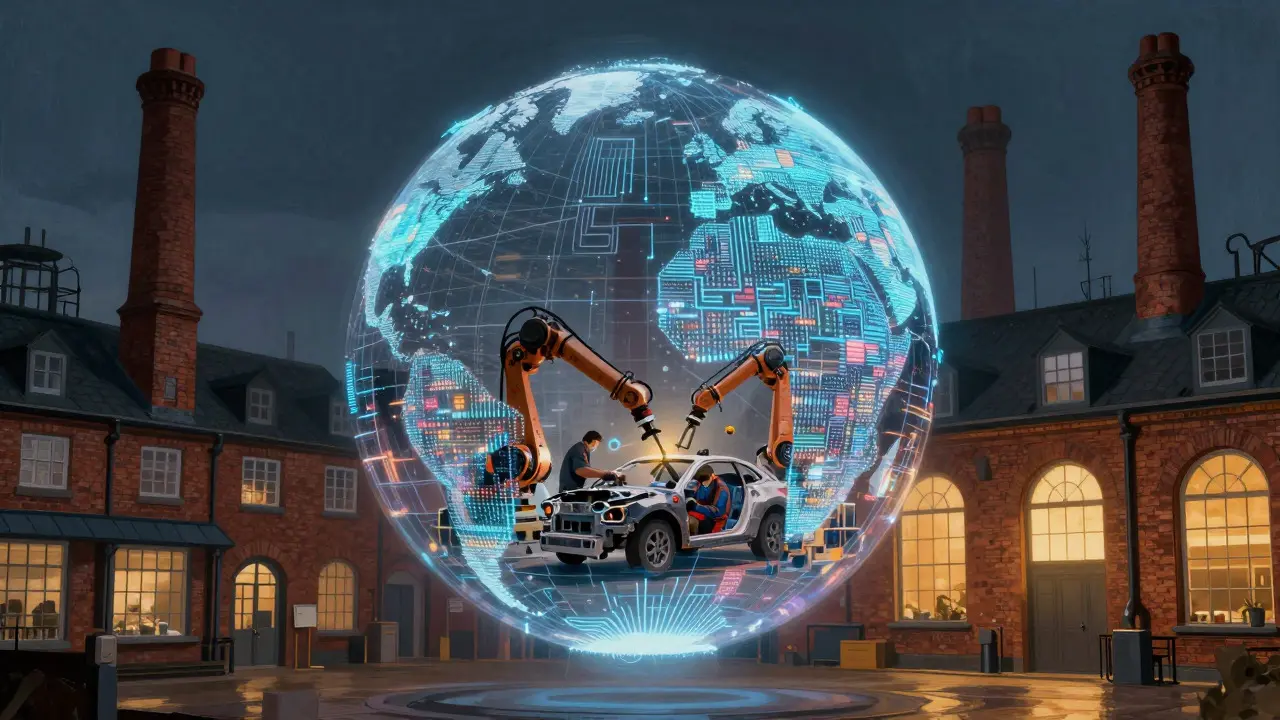
Scale and Supply Chain Efficiency
Manufacturing a luxury car is expensive. To make a profit, you need volume. British brands often produced fewer than 50,000 units per year. That’s a tough number to hit when your fixed costs are spread across such a small base. Global ownership provided the scale needed to negotiate better deals with suppliers.
Consider the case of Mercedes-Benz and its relationship with smart car technologies, or how Toyota manages its global parts network. While British brands don’t always share direct parts with their parent companies due to brand positioning, they benefit from the sheer purchasing power of their owners. When a major global group buys airbags, seats, or infotainment screens, they buy in millions of units. Their subsidiaries, including British brands, can often access these pre-negotiated contracts, reducing unit costs significantly.
| Brand | Parent Company | Year of Acquisition | Key Benefit Received |
|---|---|---|---|
| Bentley | Volkswagen Group | 1998 | Shared chassis tech, increased reliability |
| Jaguar Land Rover | Tata Motors | 2008 | Massive R&D capital, global supply chain access |
| Rolls-Royce | BMW Group | 2003 | Engineering expertise, premium platform sharing |
| Aston Martin | Various (Current: Private Equity) | N/A | Flexible capital for niche production |
Preserving Heritage While Modernizing
A common fear among purists is that foreign ownership dilutes the brand identity. Will a Japanese or German company really understand what makes a British car special? History suggests they do, or at least, they respect it enough to monetize it properly.
Tata Motors, for instance, kept JLR’s headquarters in Coventry and maintained its distinct design language. They understood that the value of JLR lay in its “Britishness.” By providing the financial stability to invest in that image rather than stripping it down for cost-cutting, they actually strengthened the brand’s appeal in key markets like the US and China.
Similarly, BMW’s stewardship of Rolls-Royce has been meticulous. They built a dedicated factory in Goodwood, separate from their main operations, to ensure the craftsmanship remained untouched. This separation proves that global owners can protect heritage if they choose to treat it as a premium asset rather than a commodity.
The Risks of International Dependence
It’s not all sunshine and roses. Relying on global owners comes with risks. Currency fluctuations can eat into profits. Political tensions between countries can disrupt supply chains. And there’s always the risk that a parent company might decide to restructure, potentially downsizing the British brand to focus on more profitable ventures elsewhere.
We saw hints of this during the 2008 financial crisis, when many global groups tightened their belts. However, because British brands had already diversified their revenue streams globally through their owners, they weathered the storm better than purely domestic competitors. The lesson here is that independence in the auto industry is increasingly an illusion. Even the most “independent” brands rely on global partners for batteries, software, and semiconductors.
What This Means for the Future
As the automotive industry shifts toward electrification and software-defined vehicles, the need for global scale becomes even more critical. Developing an electric drivetrain costs billions. Only global players can afford that risk. For British brands to remain relevant, they will likely continue to lean on their international parents for technology and capital.
Does this mean the end of British engineering? Not necessarily. It means the definition of “British engineering” is evolving. It’s no longer just about building everything in-house from raw materials. It’s about curating global best practices and applying them to a unique brand vision. The capital and scale provided by global ownership haven’t killed the soul of these cars; they’ve given the soul a body strong enough to survive the 21st century.
Did foreign ownership ruin the quality of British cars?
Generally, no. Most data shows that reliability and build quality improved after acquisition. Access to global engineering standards and stricter quality control processes from parent companies helped reduce defects. However, some enthusiasts argue that the unique hand-crafted feel has been slightly standardized to meet mass-market expectations.
Which British car brand is currently most successful due to global ownership?
Jaguar Land Rover (JLR) is widely considered the biggest success story. Under Tata Motors, it transformed from a struggling legacy brand into a top-tier global competitor, consistently ranking among the highest-selling luxury manufacturers worldwide.
Can a British car brand succeed without a global parent company?
It is extremely difficult. While niche hypercar makers like McLaren (which has complex ownership structures) or Aston Martin (with flexible private equity backing) manage to operate independently, they face constant financial pressure. The scale required for mainstream luxury sedans and SUVs usually necessitates a larger corporate backer.
How does global ownership affect job security in UK factories?
It provides a layer of protection. Global owners are less likely to close a plant quickly compared to a distressed domestic owner who needs immediate cash flow. However, automation and shifts to electric vehicle production still pose long-term challenges to traditional assembly roles, regardless of ownership structure.
Do global owners prioritize profit over heritage?
They balance both. Heritage is a marketing asset that drives higher margins. Therefore, preserving the brand story is often in the financial interest of the global owner. If the heritage fades, the premium pricing power disappears, making the brand less profitable.