How British Car Production Scaled Up During the Edwardian Era
 Nov, 17 2026
You might think of Edwardian car production as a quaint era of brass lamps and leather seats. But behind the polished veneer of luxury touring cars lay a brutal industrial shift. Between 1901 and 1910, Britain’s motor industry didn’t just grow; it fundamentally changed how machines were built. We moved from one-off craftsman builds to something resembling modern assembly lines, driven by necessity, war preparation, and a fierce desire to beat foreign competitors.
This period wasn’t about inventing the wheel. It was about figuring out how to make wheels fast, cheap, and identical. If you’re interested in how the British automotive industry transformed from a hobbyist pursuit into a global powerhouse, you need to look at the specific methods that emerged during this decade. The lessons learned here still echo in factories today.
The Starting Point: Hand-Crafted Chaos
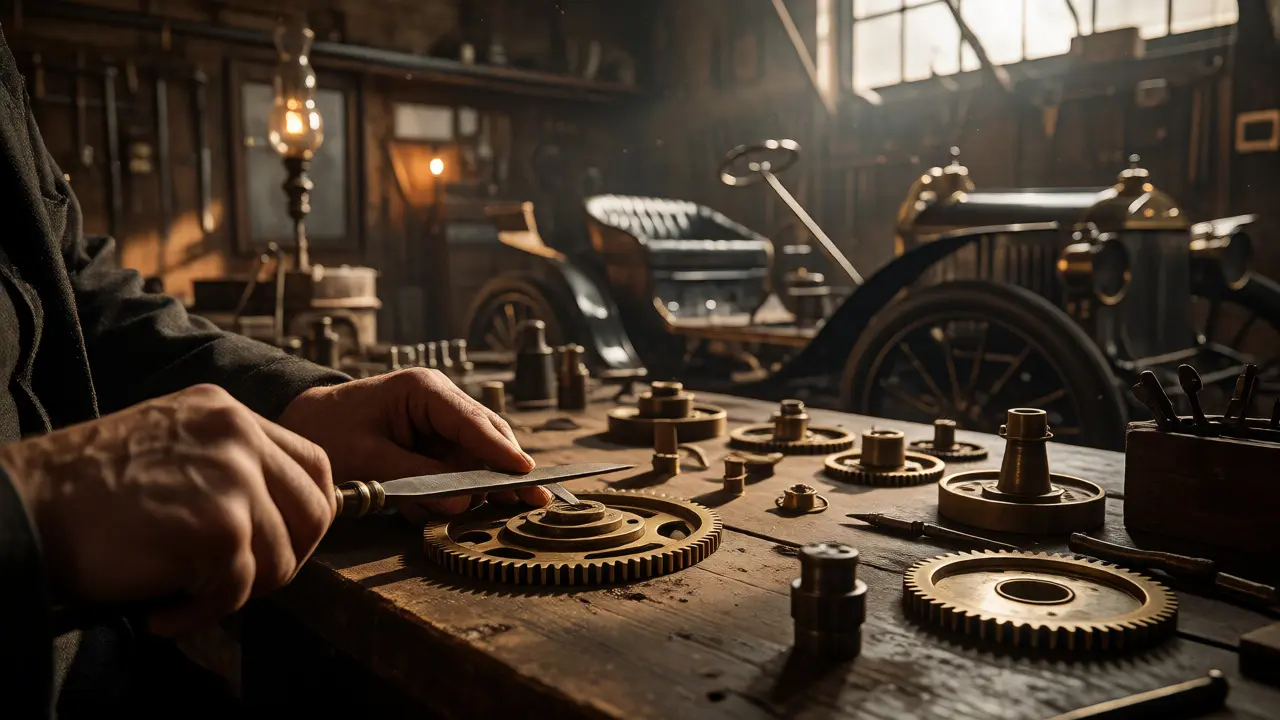
In the late Victorian era, building a car was an artisanal job. A skilled mechanic would spend weeks hand-fitting parts for a single client. Every bolt was filed to fit, every gear cut by hand. This method produced beautiful, unique machines, but it had two fatal flaws: cost and interchangeability.
If a part broke on your Panhard et Levassor or early Daimler, you couldn’t just buy a replacement off the shelf. You needed the original maker to recreate it, often requiring the car itself to be shipped back to the workshop. This lack of standardization meant that scaling up was nearly impossible. You couldn’t hire unskilled laborers because they lacked the finesse to hand-fit complex mechanisms. The bottleneck was always human skill.
The American Influence: Enter Henry Royce and Frederick Lanchester
While Americans like Ransom Olds and later Henry Ford pushed for extreme volume, British engineers took a different path. They wanted scale without sacrificing the quality that defined British prestige. Two figures stand out in this transition: Henry Royce and Frederick Lanchester.
Royce started as an electrical engineer who applied rigorous precision to internal combustion engines. His partnership with Charles Rolls created Rolls-Royce, which became synonymous with reliability. Royce insisted on tight tolerances-parts had to fit within thousandths of an inch. This wasn’t just perfectionism; it was a strategy to allow for some level of part interchangeability while maintaining high standards.
Lanchester, meanwhile, introduced innovations like disc brakes and monocoque body designs. He experimented with production techniques that reduced assembly time. These engineers proved that you could apply scientific management principles to motoring without turning the product into a soulless commodity.
Standardization: The Key to Scale
The biggest hurdle to scaling production was non-standard parts. In 1905, if you bought a chassis from Sunbeam, its bolts might not match those from Napier. This chaos drove up costs for manufacturers and repair shops alike.
The solution came through gradual standardization. Manufacturers began agreeing on common thread sizes, battery voltages, and lighting connections. While full national standards wouldn’t arrive until later, the Edwardian period saw the first serious attempts at modular design. Engines were grouped into standard displacement classes. Chassis frames were built in set lengths. This allowed factories to stockpile specific components rather than making everything from scratch for each order.
| Feature | Late Victorian (Pre-1901) | Edwardian (1901-1910) |
|---|---|---|
| Production Volume | Tens per year | Hundreds to thousands per year |
| Part Interchangeability | Low (Hand-fitted) | Moderate (Machine-tooled) |
| Labor Skill Level | Highly Skilled Artisans | Mixed (Skilled + Semi-skilled) |
| Assembly Method | Stationary (Car stays put) | Early Moving Lines / Sub-assembly |
| Primary Market | Wealthy Hobbyists | Upper-Middle Class & Commercial Fleets |
The Rise of the Moving Assembly Line
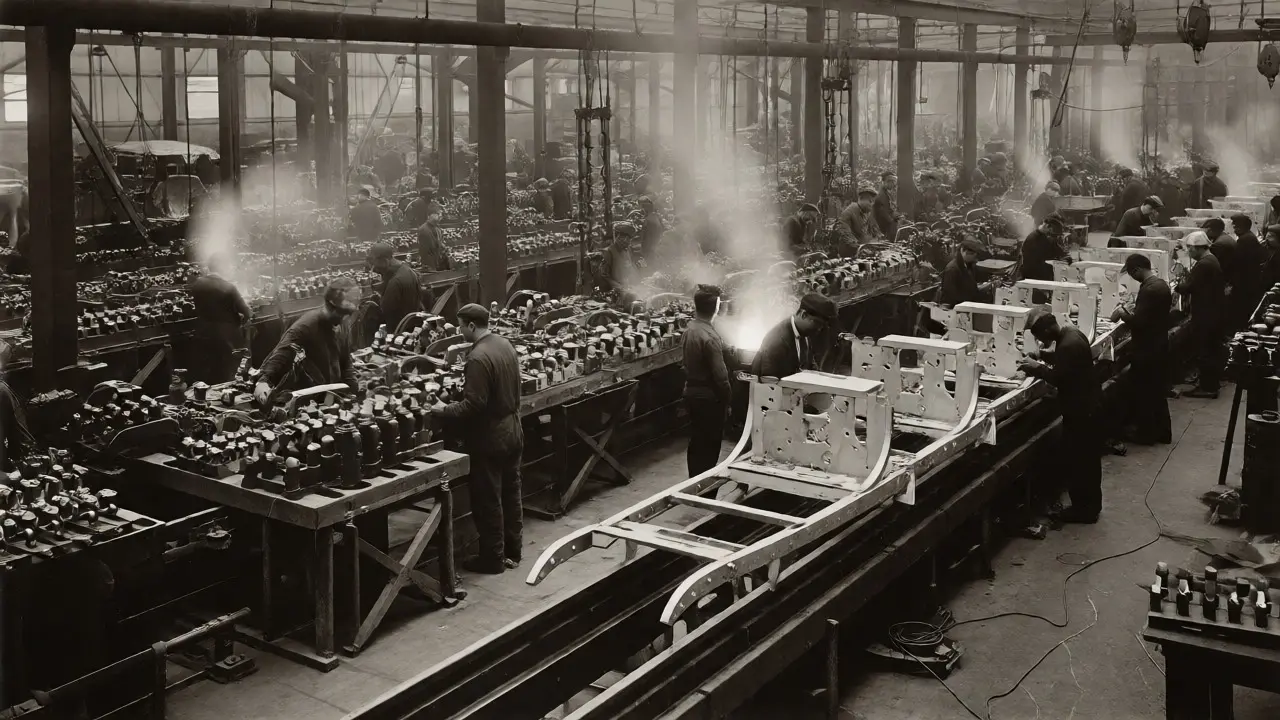
Contrary to popular belief, the moving assembly line wasn’t invented overnight by Ford in 1913. British factories began experimenting with conveyor systems and sub-assembly stations earlier. Companies like Austin Motor Company under Herbert Austin pioneered methods where workers stayed in place while parts moved toward them, or vice versa.
Austin’s factory in Longbridge, Birmingham, is a prime example. By 1908, he was producing over 1,000 cars a year-a massive jump from previous decades. How? He broke down the assembly process into smaller, repeatable tasks. Instead of one man building an entire engine, one worker installed pistons, another fitted bearings, and a third assembled the crankcase. This division of labor reduced training time and increased speed.
It wasn’t perfect. Early lines were slow and prone to jams. But the principle held: specialization breeds efficiency. This approach allowed manufacturers to hire less experienced workers, expanding the labor pool beyond the elite guilds of craftsmen.
Materials and Engineering Advances
Scaling production required better materials. Cast iron was heavy and brittle. Steel was stronger but harder to work with using older tools. The Edwardian period saw widespread adoption of vanadium steel and improved heat-treatment processes. These advancements made parts lighter, stronger, and more consistent.
Better metallurgy meant fewer defects. When you produce hundreds of gears instead of ten, a 1% defect rate becomes a disaster. Improved quality control measures, such as gauge testing and statistical sampling, became essential. Factories invested in precise measuring instruments, ensuring that a piston made in Monday’s shift fit a cylinder bored on Tuesday’s.
Electrical systems also standardized. The move from acetylene gas lamps to electric headlights and ignition systems required new wiring harnesses and switchgear. These components were ideal candidates for mass production because they were small, repetitive, and critical for safety.
Economic Pressures and Global Competition
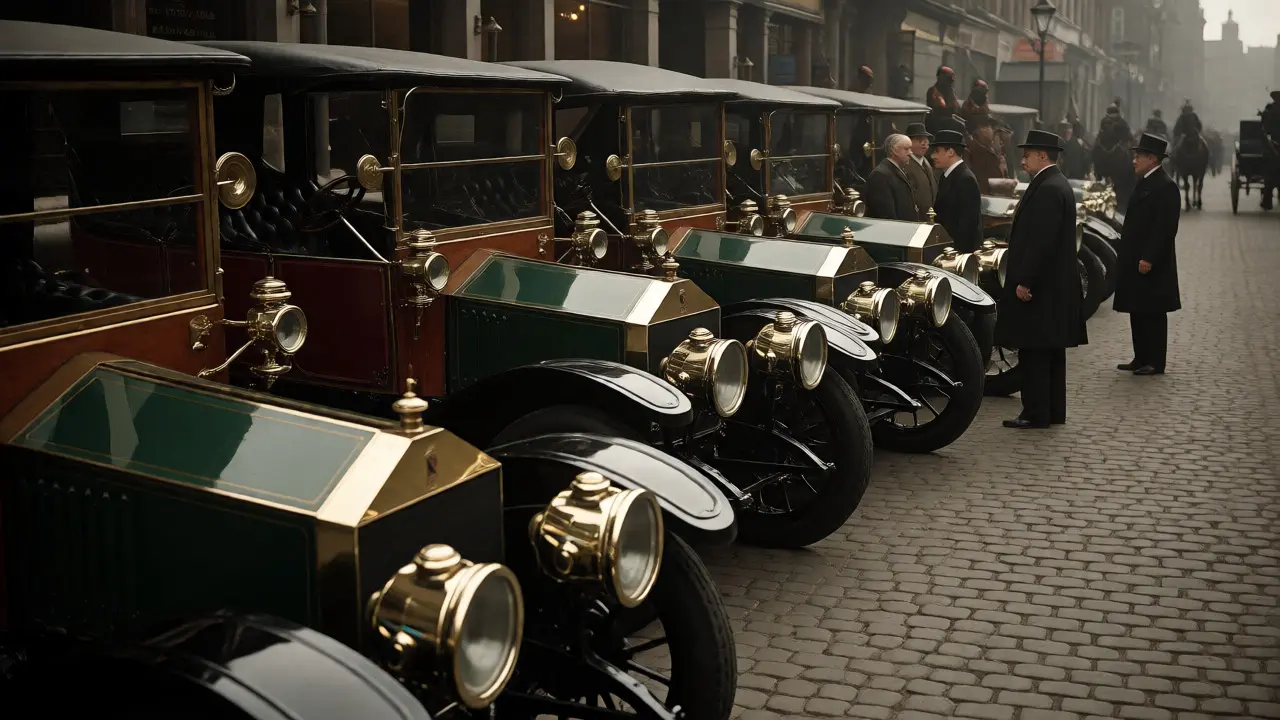
Why did all this change happen so quickly? Money and fear. French manufacturers dominated the early market, exporting thousands of cars to Britain. German firms were closing the gap. British makers realized that if they stuck to hand-crafting, they’d lose the domestic market entirely.
Commercial vehicles played a huge role here. Taxi fleets, delivery vans, and police cars needed reliable, maintainable machines. A hand-built car that required a specialist mechanic for every repair was useless for a taxi driver earning pennies per fare. Standardized, durable cars won these contracts. This commercial demand provided the stable volume needed to justify investing in expensive machinery and tooling.
The government also played a subtle role. Military interest in motor transport grew after the Boer War. Officials recognized that a strong domestic auto industry was strategic. While subsidies weren’t as direct as in later wars, the prestige associated with British engineering encouraged investment in higher-quality, scalable production methods.
The Human Cost of Progress
We shouldn’t romanticize this shift. For many skilled artisans, the rise of semi-skilled assembly work was a threat. Wages stagnated for lower-tier workers, while profits concentrated among owners and shareholders. Working conditions in factories like those in Coventry and Birmingham were often harsh-noisy, dirty, and dangerous.
However, it also created new opportunities. Mechanics became specialized technicians. Engineers gained prominence. The middle class could now afford cars, fueling further demand. The ecosystem expanded to include dealerships, repair shops, and parts suppliers, creating a robust automotive economy.
Legacy of the Edwardian Shift
By 1910, Britain had laid the groundwork for its status as a leading automotive nation. The methods developed then-standardization, sub-assembly, quality control-became the bedrock of 20th-century manufacturing. When World War I hit, British factories could pivot rapidly to produce munitions and military vehicles because they already understood scaled production.
Today, when you walk into a dealership or watch a robotic arm weld a chassis, you’re seeing the descendants of Edwardian experiments. The tension between craftsmanship and efficiency remains, but the basic playbook was written over a century ago. Understanding this period helps us appreciate why certain brands survived and others vanished. Those who adapted to scale thrived; those who clung to pure craft faded away.
Did the moving assembly line exist before Henry Ford?
Yes, rudimentary forms existed. British manufacturers like Austin used elements of moving assembly and sub-assembly before Ford’s 1913 innovation. However, Ford perfected the continuous flow system for maximum volume.
Why were British cars considered superior to American ones in this era?
British cars prioritized finish, ride quality, and engineering sophistication over sheer volume. Brands like Rolls-Royce and Bentley focused on luxury and durability, appealing to buyers who valued prestige over low cost.
What was the main barrier to mass production in the early 1900s?
Lack of part interchangeability. Without standardized components, every car had to be hand-assembled and fitted, preventing the use of unskilled labor and slowing down output significantly.
How did commercial vehicles influence car manufacturing?
Taxis and delivery vans required high reliability and easy maintenance. This demand pushed manufacturers to adopt standardized parts and robust designs, which benefited passenger car production too.
Which British city was the hub of Edwardian car production?
Coventry and Birmingham were major centers. Coventry had a legacy of bicycle and sewing machine manufacturing, providing skilled labor and precision tooling expertise crucial for early auto production.