Ford Manchester: How UK Assembly Reshaped British Car Economics
 Aug, 22 2026
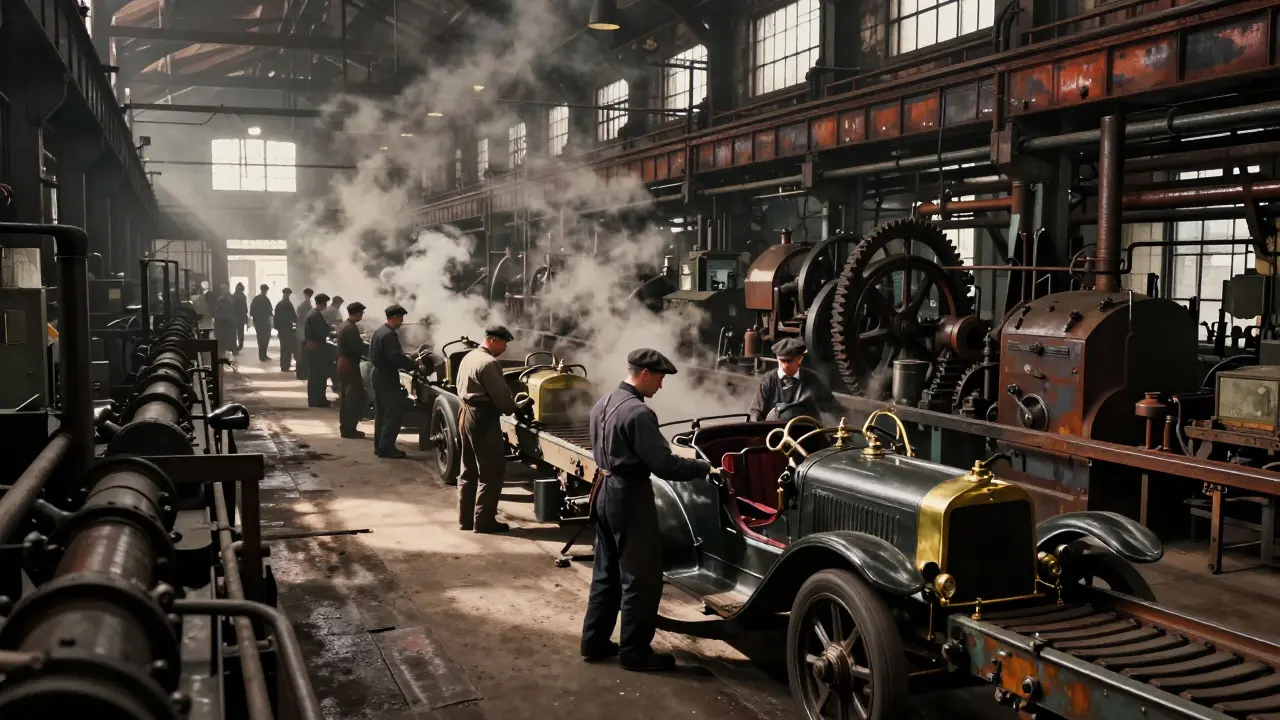
Most people picture the early 20th century as a time of steam and coal, but in Manchester, it was about steel and speed. While London debated politics, Manchester was becoming the beating heart of British industrial output. It wasn't just any factory; it was where Ford Motor Company decided to bet big on local production rather than importing finished cars from Dearborn, Michigan. This decision didn't just build cars; it fundamentally rewired how British manufacturers thought about cost, scale, and consumer access.
The story starts with a simple problem: shipping costs. In the early 1900s, importing a fully assembled vehicle across the Atlantic was expensive. Customs duties added another layer of pain. By setting up assembly lines in Manchester, Ford could bypass some of these logistical hurdles. The result? A cheaper car for the average Briton. But this wasn't just about saving money on freight. It was about creating a supply chain that could respond to local demand faster than any importer ever could.
The Manchester Advantage: Why Location Mattered
Why Manchester? It wasn't random. The city already had a dense network of skilled machinists, ironworkers, and engineers left over from the textile and cotton industries. When those mills slowed down during economic shifts, their workforce needed new jobs. Ford tapped into this existing talent pool. You didn't have to train people from scratch; you hired people who already knew how to work precision machinery. This reduced training time and lowered initial operational costs significantly.
Geography played a huge role too. Manchester sits right in the middle of the country. From there, finished vehicles could be distributed to the south, north, and west via the extensive rail network. Compare that to building in a coastal city like Liverpool or Southampton. Those ports are great for imports, but terrible for domestic distribution. Manchester offered a balance. You could receive parts by sea if needed, but more importantly, you could ship finished goods inland efficiently. This logistical setup gave Ford a competitive edge that smaller, localized competitors simply couldn't match.
Assembly vs. Import: The Economic Shift
Before Manchester, the dominant model in Britain was importation. Companies bought chassis from America or France and fitted them locally. It was flexible, but it was slow and costly. Ford’s strategy flipped this script. They moved toward full-scale assembly. This meant standardizing parts. If every bolt is the same, you don’t need a custom fitter for every single car. You need a line. And once you have a line, speed follows.
This shift changed the unit economics of car manufacturing in the UK. Let's look at the numbers conceptually. An imported car might cost £300 at the port. Add customs, add local fitting labor, add transport, and your retail price hits £450 easily. A Manchester-assembled car, using standardized parts and local labor, could drop that retail price closer to £300-£350. That £100 difference wasn't just profit margin; it was market expansion. Suddenly, a car wasn't just for the wealthy. It was entering the realm of the upper-middle class. This mass-market penetration is what we call "economies of scale" in action.
| Factor | Import Model | Local Assembly (Manchester) |
|---|---|---|
| Initial Capital Cost | Low (No factory needed) | High (Factory construction) |
| Unit Production Cost | High (Freight + Duties) | Lower (Standardized Labor) |
| Supply Chain Speed | Slow (Oceanic transit) | Fast (Domestic rail/road) |
| Market Responsiveness | Low (Fixed inventory) | High (Adjustable production) |
| Final Retail Price | Premium | Competitive/Mass Market |

The Ripple Effect on British Industry
Ford didn't operate in a vacuum. Their presence in Manchester forced other players to adapt. Before Ford, many British firms were artisanal workshops. After Ford, they had to industrialize or die. We saw the rise of supporting industries. Who made the glass? Who cast the wheels? Who supplied the electrical components? These weren't global giants yet; they were local suppliers growing up around the Ford plant. This created a cluster effect. Manchester became a hub not just for Ford, but for the entire automotive supply chain in the North of England.
This clustering had a secondary benefit: knowledge transfer. Engineers who worked for Ford often left to start their own companies or join rivals. They took the lessons of efficiency, standardization, and quality control with them. This diffusion of best practices raised the overall standard of British manufacturing. It wasn't just about making cars cheaper; it was about making the entire industrial ecosystem more sophisticated. The "Edwardian growth" mentioned in historical contexts isn't just about GDP figures; it's about this structural transformation of how value was created.

Labor Dynamics and Social Change
Economics isn't just about machines; it's about people. The Manchester plant introduced a different kind of labor discipline. Unlike the craft-based work of previous decades, assembly line work was repetitive and paced by the machine. This sparked debates even then. Was it dehumanizing? Yes, arguably. But did it provide steady wages to thousands of men who might otherwise have been unemployed? Absolutely. The social contract shifted. Workers traded autonomy for stability. In exchange, they gained access to products-like cars-that were previously out of reach.
This dynamic helped define the modern working class in industrial cities. It also influenced union organizing efforts. With large concentrations of workers in one place, collective bargaining became easier. Ford’s HR policies, which included higher wages compared to local averages, set a benchmark. Competitors had to follow suit to attract talent. So, the economic impact extended beyond the balance sheet and into the social fabric of Manchester. It shaped wage structures, housing demands, and community identities for decades to come.
Long-Term Legacy: Defining Mass Market Expectations
What does this mean for us today? The principles established in Manchester are still the backbone of global automotive economics. Standardization, local assembly for regional markets, and supply chain clustering are universal now. But back then, it was revolutionary. Ford proved that you could make a complex product affordable by controlling the process end-to-end. This lesson was learned quickly by other industries. Appliances, electronics, and eventually software all adopted similar models of scaling through standardization.
For historians and business students alike, the Ford Manchester case is a prime example of how location-specific advantages can create national-level economic shifts. It shows that "mass market" isn't just a marketing term; it's an engineering and logistical achievement. By anchoring production in Manchester, Ford didn't just sell cars; it taught Britain how to build them. And in doing so, it laid the groundwork for the post-war boom in British manufacturing, even if the company itself would face challenges later. The seed planted in the early 1900s grew into a forest of industrial capability that defined the region's identity for generations.
Why did Ford choose Manchester over other UK cities?
Manchester offered a pre-existing skilled workforce from the textile industry, central geographic location for domestic distribution, and strong rail infrastructure. These factors reduced both labor training costs and logistics expenses compared to coastal cities.
How did local assembly lower car prices in Britain?
Local assembly eliminated high ocean freight costs and reduced customs duties on finished goods. Additionally, standardized production methods increased efficiency, lowering the per-unit cost of manufacturing compared to small-batch import fitting.
What was the impact of Ford's presence on local suppliers?
It stimulated the growth of a local supply chain. Suppliers of glass, metal, and electrical components expanded to meet Ford's volume requirements, creating a cluster of specialized businesses that supported the broader automotive sector in Northern England.
Did Ford's strategy change labor conditions in Manchester?
Yes. It introduced assembly line work, which required different skills than traditional crafts. Ford's higher-than-average wages set a new benchmark for the region, influencing labor standards and contributing to stronger union organization among industrial workers.
Is the Manchester model still relevant today?
Absolutely. The core concepts of regional assembly hubs, supply chain clustering, and standardization for mass market affordability remain fundamental to global automotive and manufacturing strategies in the 21st century.