Colin Chapman’s Engineering Minimalism: The Art of Lightweight Design
 Apr, 9 2026
The Philosophy of Simplify, Then Add Lightness
Chapman didn't view a car as a collection of parts, but as a series of problems to solve. To him, every extra pound was a penalty. It slowed down acceleration, made the brakes work harder, and ruined the handling in the corners. If you remove 100 pounds from a car, it's the same as adding horsepower, but without the fuel cost or the engine heat. He approached Engineering Minimalism a design approach focused on removing all non-essential components to maximize efficiency and performance as a religion. This wasn't just about using thinner metal. It was about redesigning the entire architecture. Why use a heavy steel frame when you can use a space frame? Why use a heavy steering box when you can use a simpler rack-and-pinion system? This mindset led to the creation of the Lotus Seven, a car so stripped-back it was essentially a seat, an engine, and four wheels. It proved that a tiny, low-power car could outmaneuver the most expensive grand tourers of the era because it had nothing to fight against in the turns.Revolutionizing the Chassis: From Steel to Glass
Before Chapman, most cars used heavy ladder frames. They were sturdy, but they flexed under pressure and weighed a ton. Chapman introduced the Space Frame a structural system using small-diameter tubes welded together in triangles to create high rigidity with low weight. By using triangulation, he could keep the car stiff enough to handle high G-forces without needing thick, heavy beams of steel. But he didn't stop there. In the 1960s, he pushed the boundaries even further with the development of the Monocoque Chassis. Instead of a separate frame and body, he designed the body itself to be the load-bearing structure. Think of it like a soda can; it's incredibly strong for its weight because the outer skin does the work. This innovation was a game-changer for Formula One, allowing cars to be slimmer, more aerodynamic, and significantly lighter. The shift from the heavy tubular frames of the 1950s to the monocoques of the 60s is why F1 cars suddenly became agile missiles rather than lumbering beasts.| Chassis Type | Primary Material | Weight Profile | Rigidity | Key Benefit |
|---|---|---|---|---|
| Ladder Frame | Heavy Steel Beams | High | Low (Flexes) | Durability & Simplicity |
| Space Frame | Steel Tubing | Medium-Low | High | Optimal Power-to-Weight |
| Monocoque | Composite/Aluminum | Very Low | Very High | Aerodynamic Efficiency |
The Battle Against Aerodynamic Drag
Weight is only half the battle. Once you make a car light, you have to make sure the air isn't pushing it back. Chapman was one of the first to realize that a car's shape could be used to create Downforce a downward force created by the airflow over a vehicle's body, pushing the tires into the ground for better grip. He experimented with wedge shapes and spoilers, moving away from the rounded "bubble" look of the 50s. By shaping the underbody and adding wings, he found a way to make the car stick to the road without adding heavy ballast. This meant he could keep the car's mass incredibly low while still achieving cornering speeds that seemed impossible. The Lotus 49 is a perfect example of this; it combined a lightweight engine (the Cosworth DFV) with a slim, slippery body that sliced through the air. It didn't just win races; it dominated them because it was more efficient in every single physical dimension.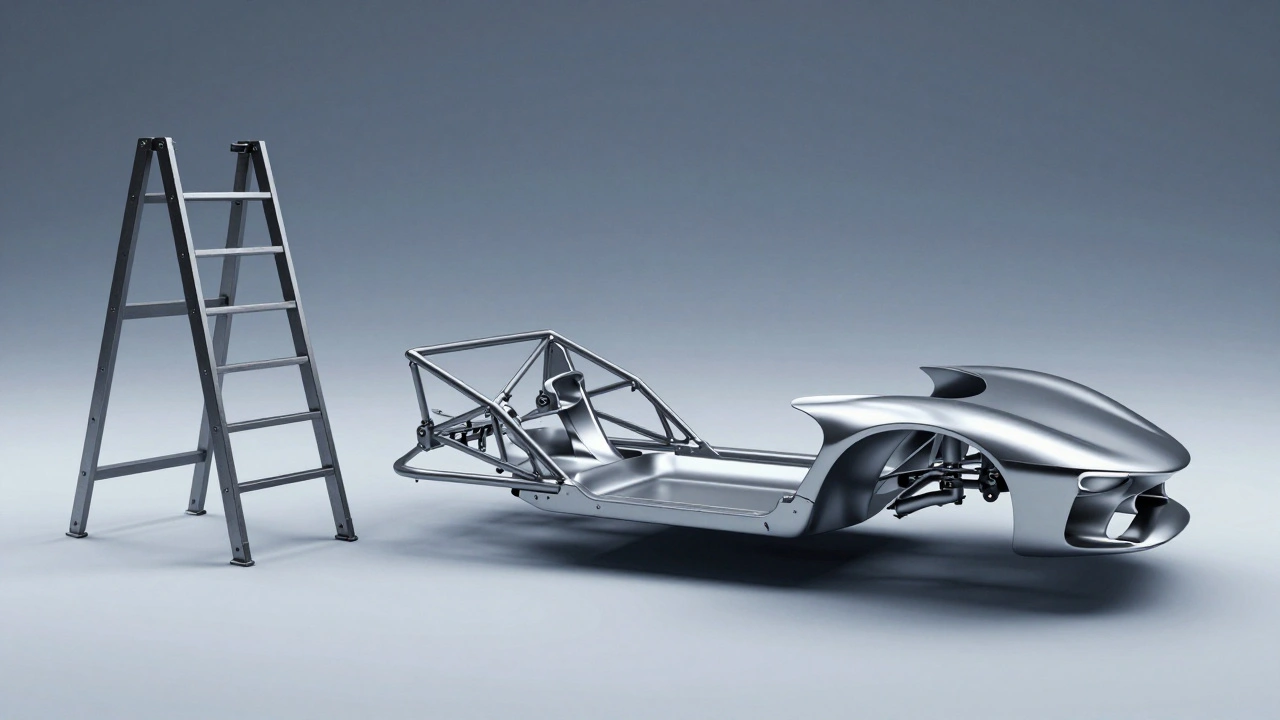
Material Science and the Risk of Minimalism
Chapman's pursuit of lightness wasn't without danger. He lived by the edge of structural failure. In his world, if a part didn't break during a race, it was probably over-engineered. This led to a reputation for "fragility," but from his perspective, he was simply finding the absolute minimum amount of material required to get the job done. He pioneered the use of Aluminum and later Glass-Reinforced Plastic (GRP) a composite material consisting of a polymer matrix reinforced with glass fibers, used to create lightweight body panels. By switching from steel panels to fiberglass, he slashed the weight of the bodywork. He also moved the engine's position and optimized the Suspension Geometry to ensure that the limited weight was distributed exactly where it needed to be. This obsession with the "marginal gain" is why a Lotus could often beat a Ferrari with double the engine displacement.The Legacy: How We Design Today
Walk into any modern performance car showroom and you'll see Chapman's ghost. When a manufacturer talks about "carbon fiber tubs" or "weight saving measures," they are speaking his language. The transition from heavy steel to Carbon Fiber Reinforced Polymer (CFRP) is the natural evolution of the monocoque ideas Chapman championed decades ago. Even in the world of Electric Vehicles (EVs), his logic holds up. Batteries are incredibly heavy. To make an EV handle like a sports car, engineers have to obsess over the weight of the chassis, the wheels, and the interior-exactly what Colin did with the Lotus Elan. He taught the world that lightness isn't just a feature; it's a performance multiplier. If you make the car lighter, you don't need as much power to go fast, which means you can use smaller brakes and lighter tires, creating a virtuous cycle of efficiency.
Practical Lessons from the Lotus Approach
If you're looking to apply the "Chapman Method" to your own projects or understanding of design, there are a few rules of thumb to follow. First, question every single component. Ask: "Does this part actually do something, or is it just there because that's how it's always been done?" Second, look for multi-purpose parts. Can the body of the car also be the frame? Can the engine mount also be a structural brace? Avoid the trap of adding "more" to fix a problem. If a car doesn't handle well, the instinct is to add stiffer springs or a bigger wing. Chapman would instead ask why the car is too heavy to begin with. By attacking the root cause-mass-you solve multiple problems at once. This is why the Lotus Esprit remained a benchmark for mid-engine balance for years; it wasn't about the peak numbers, but the harmony of the parts.What exactly does "Simplify, then add lightness" mean?
It means you should first strip a design down to its most basic, essential functions to remove complexity. Once the system is as simple as possible, you then look for ways to make those remaining parts lighter. The goal is to avoid adding complexity to solve a problem that could be fixed by simply reducing weight.
Did Colin Chapman's cars have a reputation for being unreliable?
Yes, some of his early designs were considered fragile. Because he pushed materials to their absolute limit to save weight, components sometimes failed under extreme stress. However, this was a calculated risk to achieve unmatched performance and speed on the track.
How did the monocoque chassis change racing?
The monocoque shifted the load from a heavy internal frame to the external skin of the car. This drastically reduced the overall weight and increased the torsional rigidity, meaning the car didn't twist during high-speed cornering. This allowed for much more precise handling and better aerodynamics.
Is lightweight design still relevant with modern materials?
More than ever. With the advent of carbon fiber and titanium, we can achieve weights Chapman only dreamed of. In modern EVs, reducing weight is critical because batteries are so heavy; every pound saved in the chassis extends the range and improves acceleration.
What was the Lotus Seven's impact on car design?
The Lotus Seven proved that a minimal, purpose-built machine could outperform much more powerful cars. It started the trend of "kit cars" and lightweight track toys, emphasizing that driving dynamics are more about balance and weight than raw horsepower.