British Leyland Export Failures: Currency, Quality, and Trust
 Aug, 17 2026
Imagine ordering a car in 1975. You pay the price, but by the time it ships, the pound has dropped against the dollar. Suddenly, your margin is gone. That was the daily reality for British Leyland is a major British automotive manufacturer formed in 1968 from the merger of Austin-Morris and Standard-Triumph, which faced severe financial instability due to high labor costs, poor quality control, and volatile exchange rates. The company wasn't just selling cars; it was gambling on the value of the pound while trying to fix engines that leaked oil before they even left the factory. This combination created a perfect storm that eroded customer confidence across global markets.
The core issue wasn't just one thing. It was a tangled web of macroeconomic shocks, industrial relations, and product engineering failures. To understand why BL struggled so badly with exports, we have to look at how these three factors-currency, quality, and trust-interacted during the critical years of the late 1970s and early 1980s.
The Currency Trap: When Profits Vanished Overnight
In the mid-1970s, the UK economy was under immense pressure. Inflation was high, and the value of the British Pound is the official currency of the United Kingdom, which experienced significant depreciation against the US Dollar and Deutsche Mark during the 1970s, impacting export competitiveness. For an exporter like BL, this was a nightmare scenario. They priced their vehicles based on expected future exchange rates. If the pound fell sharply, the revenue coming back in sterling terms was less than projected. Conversely, if they tried to raise prices to compensate, they lost market share to Japanese and German competitors who had more stable currencies or lower production costs.
This volatility made long-term contracts risky. Dealers in the US and Europe couldn't predict what their next shipment would cost. This uncertainty led to smaller order sizes and longer lead times. BL found itself in a reactive posture, constantly adjusting pricing strategies rather than building sustainable growth. The lack of hedging tools or sophisticated financial management meant that every swing in the foreign exchange market hit the bottom line directly.
Quality Control: The Engine Room Problem
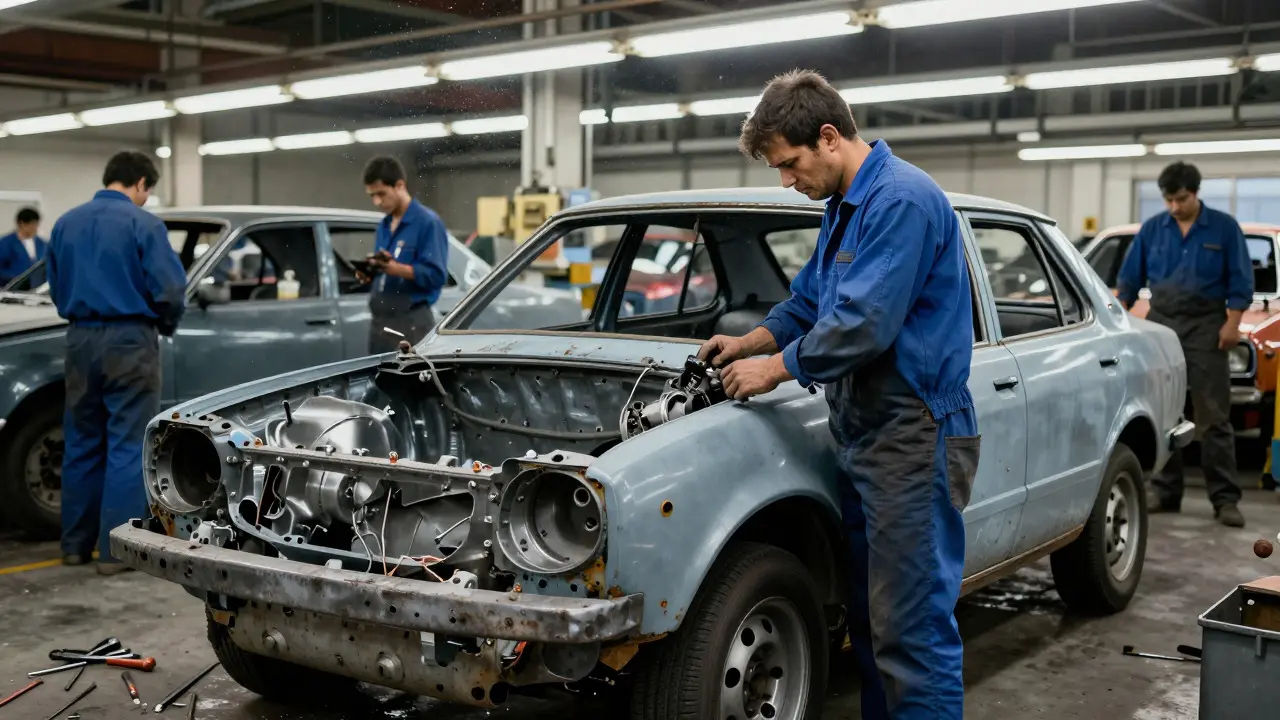
While currency issues hurt the balance sheet, quality issues hurt the brand reputation. During this period, BL suffered from widespread mechanical reliability problems. The Austin Allegro is a compact car produced by British Leyland from 1973 to 1984, known for its innovative body design but plagued by electrical faults and rust issues. was a prime example. It featured a unique monocoque construction that looked modern but proved difficult to manufacture consistently. Early models suffered from poor paint adhesion, electrical gremlins, and engine overheating.
These weren't isolated incidents. They were systemic. The manufacturing process lacked the precision seen in Toyota or Volkswagen plants. Workers often complained about inadequate training and outdated tooling. Management focused on volume rather than verification. As a result, defect rates remained stubbornly high. When a car breaks down on the highway, the driver doesn't care about the company's stock price or exchange rate policy. They care about getting home safely. This disconnect between corporate strategy and end-user experience is where customer confidence began to crumble.
Erosion of Customer Confidence: A Vicious Cycle
Confidence in a car brand is built over years and lost in weeks. Once word spread that BL cars were unreliable, dealers became hesitant to stock them. Why push a product that generates warranty claims and angry phone calls? This reduced visibility in showrooms further dampened sales. Meanwhile, existing owners shared their negative experiences in local clubs and forums, creating a narrative of unreliability that was hard to shake.
The situation was exacerbated by poor after-sales support. Parts availability was inconsistent, and service centers were often understaffed. If you bought a BL car in Canada or Australia, waiting for a specific gearbox part could take months. This logistical failure reinforced the perception that the company didn't care about its international customers. It treated them as secondary markets rather than vital partners in its survival.
Comparative Analysis: BL vs. Competitors
To see the scale of the problem, let's compare BL's performance with key rivals during the same period. The table below highlights the differences in approach and outcome.
| Manufacturer | Currency Stability Strategy | Quality Focus | Export Market Reputation |
|---|---|---|---|
| British Leyland | Reactive pricing, minimal hedging | Low consistency, high defect rates | Unreliable, expensive maintenance |
| Toyota is a Japanese multinational automobile manufacturer renowned for its lean manufacturing system, high fuel efficiency, and exceptional build quality. | Stable yen, strong domestic base | High consistency, low defect rates | Reliable, economical, well-supported |
| Volkswagen is a German multinational automotive corporation known for producing durable vehicles with robust engineering and consistent quality standards. | Strong Deutsche Mark, diversified markets | Moderate to high consistency | Durable, premium feel, good resale value |
Notice the pattern. Toyota and VW didn't just have better cars; they had better systems. Their stability allowed them to invest in quality improvements without fearing immediate cash flow crises. BL was stuck in a survival mode that prevented long-term investment in manufacturing upgrades.
The Role of Industrial Relations
You can't talk about BL's struggles without mentioning labor. Frequent strikes disrupted production schedules. When a strike hits, output drops, but fixed costs remain. This forces the company to sell fewer cars at higher per-unit costs. Moreover, strikes create uncertainty for dealers. If a dealer orders 100 cars and only receives 60, their inventory planning goes out the window. This operational chaos fed directly into the quality and confidence issues mentioned earlier. Customers waited longer for deliveries, and when cars finally arrived, they sometimes had minor defects because rushed production processes skipped final checks.

Lessons for Modern Exporters
What can we learn from this historical case? First, currency risk must be managed proactively, not reactively. Second, quality is not a cost center; it's a marketing tool. A reliable car sells itself. Third, global customers demand consistent after-sales support. If you sell internationally, you must treat those markets with the same respect as your home market. Finally, operational stability is crucial. Frequent disruptions erode trust faster than any single product flaw.
For businesses today, the principles remain the same. Whether you're exporting software, machinery, or consumer goods, the interplay between financial stability, product quality, and customer trust determines success. Ignoring any one of these pillars can lead to a slow decline, just as it did for British Leyland.
Frequently Asked Questions
Why did British Leyland struggle with exports specifically?
BL struggled with exports due to a combination of volatile exchange rates that eroded margins, inconsistent vehicle quality that damaged reputation, and poor after-sales support that reduced customer loyalty. These factors combined to make BL cars less competitive than Japanese and German rivals.
How did currency fluctuations affect BL's pricing?
Currency fluctuations forced BL to frequently adjust prices, making it difficult to maintain consistent market positioning. When the pound weakened, BL's revenues in local currencies decreased unless they raised prices, which often led to loss of market share to competitors with more stable currencies.
Which BL models were most affected by quality issues?
The Austin Allegro and the Triumph Dolfin were particularly noted for quality issues. The Allegro had electrical and rust problems, while the Dolfin suffered from engine reliability concerns. These models were prominent in export markets, amplifying the damage to the brand's reputation abroad.
Did British Leyland ever recover its export business?
Partial recovery occurred in the early 1980s with improved models like the MG Metro, but the company's overall financial health remained fragile. The brand eventually fragmented, with parts sold to other manufacturers like Rover Group, marking the end of BL as a unified entity.
What role did labor strikes play in export delays?
Labor strikes caused significant production halts, leading to delayed shipments for international dealers. This unpredictability made it hard for overseas partners to plan inventory, reducing their willingness to commit to large orders and weakening BL's position in competitive markets.