British Auto Labour: Post-War Training Programs and Apprenticeships
 Aug, 17 2026
The end of World War II left Britain with a broken economy but a massive demand for cars. Yet, there was a critical gap: the workforce needed to build them. The post-war apprenticeship system is a structured vocational training model that bridged the gap between school and industrial employment in the UK automotive sector. This wasn't just about fixing cars; it was about rebuilding an industry from scratch while managing labor shortages and technological shifts.
You might think training was straightforward. It wasn't. The British motor industry faced a unique set of challenges in the late 1940s and 1950s. Manufacturers like Vauxhall Motors and Morris Motors had to train thousands of young people quickly. But they also had to retain skilled workers who were tempted by higher wages in other sectors or overseas opportunities. Understanding this era reveals how Britain managed its human capital during a pivotal economic transition.
The State of the Workforce in 1945
When the war ended in 1945, the British automotive landscape was fragmented. Production lines were still churning out military vehicles, and civilian car production was limited. The workforce was older than it should have been because many young men had served in the armed forces. Women, who had entered the factories in large numbers during the war, were gradually pushed back into domestic roles as social norms shifted.
This created a skills vacuum. Experienced machinists and fitters were retiring or leaving the industry. New entrants lacked the foundational mechanical knowledge required for complex assembly tasks. The government, through the Ministry of Labour, stepped in to coordinate national training efforts. They recognized that without a robust pipeline of skilled tradespeople, the auto industry would struggle to meet the booming post-war demand for personal transportation.
How Apprenticeships Worked in the Motor Industry
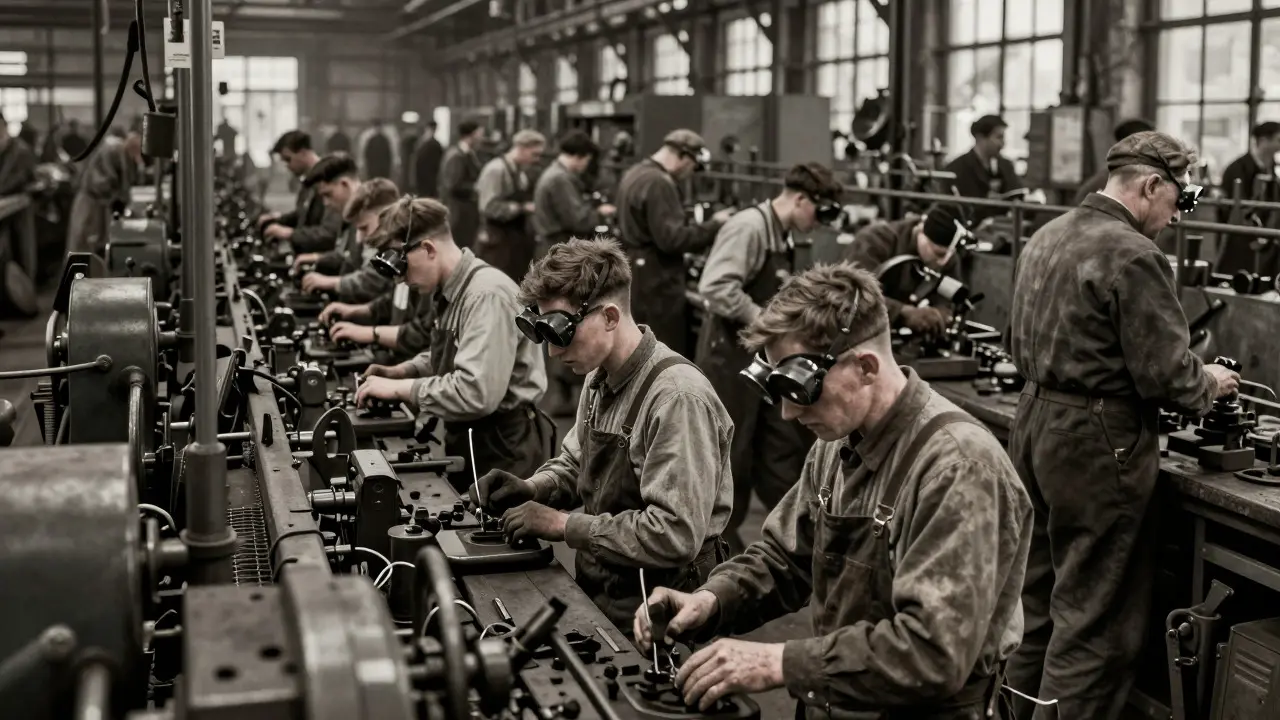
The standard apprenticeship contract in the 1950s typically lasted four years. A young person, usually aged 15 or 16, would sign on with a specific manufacturer. In exchange for their labor, which was paid at a fraction of the adult wage, they received on-the-job training and time at a local technical college.
- Weekday Training: Apprentices spent most of their week on the factory floor. They rotated through departments such as machining, welding, electrical fitting, and final assembly. This rotation ensured they understood the entire vehicle lifecycle.
- College Days: One day per week (often Saturday) was reserved for technical education. Subjects included mathematics, physics, engineering drawing, and metallurgy. This theoretical grounding was crucial for problem-solving on the shop floor.
- Assessment: Progress was monitored by both the employer and the college. Final exams determined whether the apprentice achieved a full trade qualification or a partial certificate.
This dual-system approach meant that by the end of the four years, a graduate was not just a worker but a qualified technician. They could diagnose faults, maintain equipment, and even design minor tooling modifications. This level of autonomy was a hallmark of British industrial training compared to more rigid, task-specific models emerging elsewhere.
Key Players in the Training Ecosystem
The training effort was a collaboration between private firms, educational institutions, and government bodies. The Motor Trades Association (MTA) is an industry body that represented manufacturers and suppliers in setting standards for labor relations and training. The MTA worked closely with the National Joint Council for the Motor Trade to negotiate wage scales and training conditions.
Local polytechnics and technical colleges played a vital role. Institutions like the City and Guilds of London Institute is a certification body that provided standardized testing and qualifications for engineering trades. City and Guilds certifications became the gold standard for proving competency. An apprentice who passed their City and Guilds exam held a credential recognized across the entire UK, making them highly mobile within the labor market.
| Metric | 1950s Average | 1960s Average |
|---|---|---|
| Average Apprenticeship Duration | 4 Years | 3-4 Years (Shortened in some firms) |
| Weekly College Hours | 8-10 Hours | 6-8 Hours |
| Pass Rate for Full Qualification | Approx. 70% | Approx. 85% |
| Primary Focus Area | Mechanical Fitting & Machining | Electrical Systems & Automation |

The Shift Toward Specialization
As the 1950s progressed, the nature of car manufacturing changed. The introduction of automatic transmissions, power steering, and increasingly complex engine designs required new skill sets. The traditional "jack-of-all-trades" mechanic was no longer sufficient. Factories began to specialize their training programs.
Electrical training became a distinct track. Previously, wiring harnesses were simple. By the mid-1950s, vehicles had multiple electrical systems for lighting, ignition, and accessories. Apprentices now needed to understand circuit diagrams and diagnostic tools. Similarly, the rise of automated welding and stamping presses meant that operators needed to monitor machines rather than perform manual fabrication. This shift reduced the need for pure muscle power and increased the value of analytical thinking.
However, this specialization also created rigidity. Workers trained for one specific machine type often found it difficult to move to another department or company. This lack of flexibility became a point of contention in labor negotiations later in the decade.
Challenges and Labor Relations
Training wasn't always smooth sailing. Disputes over pay rates for apprentices were common. Unions argued that the low wages during the training period exploited young workers. Employers countered that the investment in training justified the lower initial pay. The resolution often came through the National Joint Council, which established minimum wage scales for each year of the apprenticeship.
Another major issue was retention. Once an apprentice completed their training and earned their qualification, they were free to leave. Many did, moving to competitors or different industries where starting salaries for qualified technicians were higher. To combat this, some manufacturers offered bonuses or housing assistance to keep newly qualified staff. This brain drain forced companies to constantly replenish their intake of new apprentices, creating a perpetual cycle of recruitment and training.

Impact on Productivity and Quality
The investment in training paid off in terms of product quality. British cars in the late 1950s and early 1960s were known for their robust construction and reliability. This reputation was built on the backs of skilled workers who took pride in their craft. The attention to detail required by the apprenticeship system resulted in tighter tolerances and fewer defects on the assembly line.
Productivity metrics improved significantly between 1950 and 1960. Output per worker rose by approximately 20% in the major motor plants. While automation contributed to this, the primary driver was the enhanced skill level of the workforce. Skilled workers could identify bottlenecks, suggest improvements, and operate machinery more efficiently than untrained labor.
Legacy and Modern Relevance
The post-war apprenticeship system laid the foundation for modern vocational education in the UK. While the structure has evolved, the core principle remains: combining practical experience with theoretical knowledge produces competent professionals. Today, similar models exist in the form of T-levels and modern apprenticeships, though the pace of technological change has accelerated the need for continuous upskilling.
For historians and business analysts, this era offers valuable lessons. It demonstrates that investing in human capital is not just a cost center but a strategic asset. The success of the British auto industry in the 1950s was not solely due to better designs or marketing, but because the people building the cars had the skills to do so effectively. As we look at current labor markets, the importance of structured, long-term training programs becomes even more apparent in an age of rapid technological disruption.
How long did a typical apprenticeship last in the 1950s?
Most apprenticeships in the British motor industry lasted four years. Some specialized roles, such as electrical fitting, could be shorter, around three years, but the standard mechanical trade qualification required the full four-year commitment including college attendance.
What was the difference between an apprentice and a journeyman?
An apprentice was a trainee working under supervision and earning a lower wage. A journeyman was a fully qualified worker who had completed their training and exams. Journeymen earned full adult wages and could work independently, often taking on supervisory duties or handling complex repairs without direct oversight.
Did women participate in these training programs?
Participation was limited but present. While the majority of apprentices were male, women did enter training programs for specific roles like sewing (for upholstery) and later, electrical inspection. However, cultural barriers and union rules often restricted women's access to heavy mechanical trades during this period.
Which qualifications were most valued by employers?
City and Guilds certificates were the most highly regarded. Holding a full City and Guilds qualification in a trade like Mechanical Engineering or Electrical Engineering signaled to any employer in the UK that the worker met national standards of competency. Internal company certificates were respected but less portable across different manufacturers.
How did training costs affect car prices?
Training costs were absorbed into the overall operational expenses of the manufacturers. While they didn't directly add a visible line item to the car price, efficient training led to higher productivity and lower defect rates, which helped keep manufacturing costs stable. Poorly trained workers would increase costs through rework and waste, potentially raising prices.